Showing posts with label middle. Show all posts

Wednesday, November 26, 2014

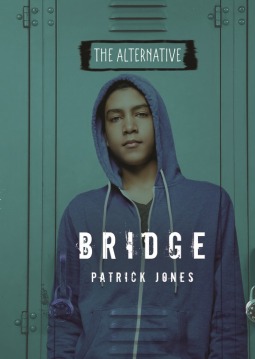
Bridge by Patrick Jones


Jones, P. (2014). The Alternative: Bridge. Minneapolis, MN: Darby Creek.

Summary: After his father experiences a debilitating accident, José has to make tough decisions for his family. He has to decide how to support them as well as do the right thing for himself. He has to decide whether to stay in school or work full time.

Review: I met Patrick Jones recently at the YALSA Lit Symposium and admired his commitment to writing for reluctant readers and for students of color. This text is at an appropriate reading level for many of my students and it is about an immigrant Latino family who struggles. Unfortunately, Jones' portrayal of family appears to be one of deficit instead of value. José appears to be a martyr for his family with the help of his hero-like teachers.

Diversity: This novel centers around a Latino family.

Suggestions for Teachers: This text would be best in a classroom library. I would have students, especially my Latino students, analyze Jones' portrayal of family.

Reading Level:

  1. Quantitative: Lexile 800L, ATOS Book Level9.67-12.01, Flesh-Kincaid 8.32-12.12,8.41-10.81RMM
  2. Qualitative: This text is slightly complex; it is chronological. The language is largely contemporary and familiar. Those who have knowledge of immigration issues will have a stronger understanding.
Content Areas: English

Common Core State Standards:

CCSS.ELA-LITERACY.RL.9-10.2
Determine a theme or central idea of a text and analyze in detail its development over the course of the text, including how it emerges and is shaped and refined by specific details; provide an objective summary of the text.
CCSS.ELA-LITERACY.RL.9-10.3
Analyze how complex characters (e.g., those with multiple or conflicting motivations) develop over the course of a text, interact with other characters, and advance the plot or develop the theme.
Relevant links: Teaching Books
Subjects/Themes: family, acceptance, values, immigration


Awards: N/A

Series Information: The Alternative series

Sunday, September 21, 2014

Animal Poems by Valerie Worth, Illustrated by Steve Jenkins

     
Worth, V. (2007). Animal poems (S. Jenkins, Illustrator). New York, NY: Farrar Straus Giroux.

Summary: Valerie Worth's poems about animals are paired with Steve Jenkins multi-textured artwork.

Review: Worth's poetry ranges from simple to very difficult. Lots of vocabulary will be challenging for younger children but what a great vehicle to teach vocabulary and description.

Suggestions for Teachers: Older students could deconstruct and analyze poems. Younger students will enjoy hearing these poems read aloud. Individual poems could be paired with a science unit as an interactive read aloud. Students can use these poems as models to create their own animal poems. Art teachers can use the artwork as examples or models for students to create their own animals.


Reading Level:

  1. Quantitative: Lexile 1720L, ATOS Book Level 12.0, Flesh-Kincaid 23.6 Readability Grade Level 21.1, RMM N/A
  2. Qualitative:  This is an extremely complex text. As an adult, I struggled with visualizing because much of the vocabulary is content-specific to the animal itself. When testing the poem "Jellyfish" through the quantitative analyzers, I wasn't surprised to see this as grad school level. While the poems are short, they are filled with lots of dense, unfamiliar vocabulary. Other poems like "Cockroach" incorporate a first person narrator and other poems like "Groundhog" have two line stanzas. The structure and perspective shifts between poems. Poems have few complete stops and will take multiple reads to fully understand. Figurative language will also make poems challenging. The artwork is essential in making these poems more accessible.
Content Areas: English, Science, Art

Common Core State Standards:

CCSS.ELA-LITERACY.RL.5.2
Determine a theme of a story, drama, or poem from details in the text, including how characters in a story or drama respond to challenges or how the speaker in a poem reflects upon a topic; summarize the text.
CCSS.ELA-LITERACY.RL.5.4
Determine the meaning of words and phrases as they are used in a text, including figurative language such as metaphors and similes.
CCSS.ELA-LITERACY.RL.5.7
Analyze how visual and multimedia elements contribute to the meaning, tone, or beauty of a text (e.g., graphic novel, multimedia presentation of fiction, folktale, myth, poem).
CCSS.ELA-LITERACY.L.5.4.A
Use context (e.g., cause/effect relationships and comparisons in text) as a clue to the meaning of a word or phrase.

CCSS.ELA-LITERACY.L.5.5
Demonstrate understanding of figurative language, word relationships, and nuances in word meanings.
Relevant links: Scholastic
Subjects/Themes: poetry, animals, art
Awards: N/A
Series Information: N/A