Showing posts with label high school. Show all posts

Monday, December 1, 2014

This I Believe essays


Special features. (2005). Retrieved December 1, 2014, from http://thisibelieve.org/feature/

Summary: This is a collection of "This I Believe" essays and podcasts organized by topic.  

Review:  These short essays are engaging and are often models to help students craft their own belief statements.

Diversity: These essays feature diverse voices.

Suggestions for Teachers: These essays can serve as models for students to craft their own personal essays. They also can be used with various topical units. They can be used to analyze the craft of this type of non-fiction. Students may also contribute their own personal essay to This I Believe.
  1. Quantitative: N/A
  2. Qualitative: No background information is necessary. These essays are meant to stand alone. Depending on the subject and author, language will vary although it is overall contemporary and familiar. Organization often includes anecdotes or memories to support evidence and thesis.
Content Areas: English, Contemporary Issues, Social Studies

Common Core State Standards:


CCSS.ELA-LITERACY.CCRA.R.1
Read closely to determine what the text says explicitly and to make logical inferences from it; cite specific textual evidence when writing or speaking to support conclusions drawn from the text.
CCSS.ELA-LITERACY.CCRA.R.2
Determine central ideas or themes of a text and analyze their development; summarize the key supporting details and ideas.
CCSS.ELA-LITERACY.CCRA.R.3
Analyze how and why individuals, events, or ideas develop and interact over the course of a text.

Relevant links: This I Believe
Subjects/Themes: English, Social Studies, Personal Narrative


Awards: N/A

Series Information: N/A

The Matrix film directed by The Wachowskis


Wachowski, L., & Wachowski, A. (Directors). (1999). The matrix [Motion picture]. US: Warner Bros.


Summary: Thomas Anderson leads a mundane life as an office worker by day and a hacker by night.  He meets Morpheus who convinces him that once he knows the truth, he will never want to return to his old life and will try to convince others to see the truth too.

Review:  While there are some violent scenes, this is an excellent film for high school students when grappling Plato's Allegory of the Cave.

Diversity: Talk about characters who do not fit the "norm". Here it is cool to be alternative. Keanu Reeves and Laurence Fishburne are also men of color.


Suggestions for Teachers: Show clips of this film while teaching Plato's Allegory of the Cave. Read it with Malcolm X's "Learning to Read". What other texts talk about the truth being powerful?

Reading Level:

  1. Quantitative: N/A
  2. Qualitative: High interest and complex ideas. Students will be able to use this film to make meaning of Plato. Knowledge of computer hacking will help students make meaning. Overall, easy to follow.
Content Areas: English, Philosophy

Common Core State Standards:


CCSS.ELA-LITERACY.CCRA.R.1
Read closely to determine what the text says explicitly and to make logical inferences from it; cite specific textual evidence when writing or speaking to support conclusions drawn from the text.
CCSS.ELA-LITERACY.CCRA.R.2
Determine central ideas or themes of a text and analyze their development; summarize the key supporting details and ideas.
CCSS.ELA-LITERACY.CCRA.R.3
Analyze how and why individuals, events, or ideas develop and interact over the course of a text.

Relevant links: Wikipedia, History Guide
Subjects/Themes: philosophy, Plato, English


Awards: See here.

Series Information: N/A

Wednesday, November 26, 2014

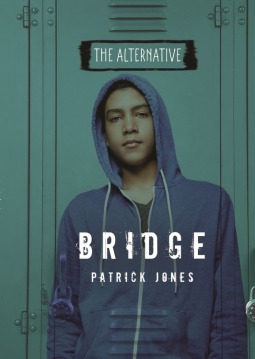
Bridge by Patrick Jones


Jones, P. (2014). The Alternative: Bridge. Minneapolis, MN: Darby Creek.

Summary: After his father experiences a debilitating accident, José has to make tough decisions for his family. He has to decide how to support them as well as do the right thing for himself. He has to decide whether to stay in school or work full time.

Review: I met Patrick Jones recently at the YALSA Lit Symposium and admired his commitment to writing for reluctant readers and for students of color. This text is at an appropriate reading level for many of my students and it is about an immigrant Latino family who struggles. Unfortunately, Jones' portrayal of family appears to be one of deficit instead of value. José appears to be a martyr for his family with the help of his hero-like teachers.

Diversity: This novel centers around a Latino family.

Suggestions for Teachers: This text would be best in a classroom library. I would have students, especially my Latino students, analyze Jones' portrayal of family.

Reading Level:

  1. Quantitative: Lexile 800L, ATOS Book Level9.67-12.01, Flesh-Kincaid 8.32-12.12,8.41-10.81RMM
  2. Qualitative: This text is slightly complex; it is chronological. The language is largely contemporary and familiar. Those who have knowledge of immigration issues will have a stronger understanding.
Content Areas: English

Common Core State Standards:

CCSS.ELA-LITERACY.RL.9-10.2
Determine a theme or central idea of a text and analyze in detail its development over the course of the text, including how it emerges and is shaped and refined by specific details; provide an objective summary of the text.
CCSS.ELA-LITERACY.RL.9-10.3
Analyze how complex characters (e.g., those with multiple or conflicting motivations) develop over the course of a text, interact with other characters, and advance the plot or develop the theme.
Relevant links: Teaching Books
Subjects/Themes: family, acceptance, values, immigration


Awards: N/A

Series Information: The Alternative series

Monday, November 24, 2014

Living with Jackie Chan by Jo Knowles


Knowles, J. (2013). Jumping Off Swings: Vol. 2. Living with Jackie Chan. New York, NY: Candlewick.

Summary: Josh is spending his senior year of high school with his Uncle Larry, a man who bases his life off the principles of karate. Josh needs this distraction as he is dealing with his own internal turmoil, leaving his hometown with his own secret. He makes friends, teaches karate and even develops a crush trying to suppress his past. Will it come back to haunt him?

Review: An interesting read of internal conflict. Made me very curious about the first part of this series.

Diversity: Upstairs neighbors in this book are gay parents.

Suggestions for Teachers: Use this in a coming-of-age unit or for lit circles.

Reading Level:

  1. Quantitative: Lexile 530, ATOS Book Level 9.67-12.01, Flesh-Kincaid 8.32-12.12, 8.41-10.81 RMM
  2. Qualitative: This text is slightly complex. It is organized chronologically and there are a few flashbacks. Vocabulary is contemporary and familiar. Those who have read the first book in the series will have a stronger understanding of the story.
Content Areas: English

Common Core State Standards:

CCSS.ELA-LITERACY.RL.9-10.2
Determine a theme or central idea of a text and analyze in detail its development over the course of the text, including how it emerges and is shaped and refined by specific details; provide an objective summary of the text.
CCSS.ELA-LITERACY.RL.9-10.3
Analyze how complex characters (e.g., those with multiple or conflicting motivations) develop over the course of a text, interact with other characters, and advance the plot or develop the theme.
Relevant links: Teaching Books, Jo Knowles
Subjects/Themes: family, acceptance, teen pregnancy


Awards: N/A

Series Information: N/A

Saturday, November 22, 2014

The Port Chicago 50: Disaster, Mutiny and the Fight for Civil Rights by Steve Sheinkin


Sheinkin, S. (2014). The Port Chicago 50: Disaster, mutiny and the fight for civil rights. New York, NY: Roaring Brook.

Summary: In July 1944, an explosion killed 300 African American men and injured many more. Black men were stationed at this Bay Area naval base doing the dangerous work of loading heavy explosives onto ships without any training or safety measures. White officers ordered Black men to do this work even after the explosion. This is the story of the 50 men who said they wouldn't return to this job. These men were accused of mutiny and the punishment was death by rifle. This is their story.

Review: An accessible and fascinating look at one of the greatest injustices to African Americans, and arguably the birth of the Civil Rights Movement. Sheinkin makes the stories of Joe Small and his men come alive and you can't help but feel the moral contempt here. I kept wondering what I would have said or done. I only hoped to have been so brave.

Diversity: An beautiful portrayal of humanity and bravery of the Port Chicago 50.

Suggestions for Teachers: Teach this book for US history. Teach it as part of WWII. Teach it when teaching research and primary and secondary resources.

Reading Level:

  1. Quantitative: Lexile 950, ATOS Book Level 7.00-9.98, Flesh-Kincaid 6.51-10.34, 7.04-9.57 RMM
  2. Qualitative: This text is moderately complex. It is organized chronologically. Through personal stories, this text comes alive for readers. There is some technical vocabulary and there are lots of details that students may either be excited by or overwhelmed by, but Sheinkin does a phenomenal job of creating suspense. Knowledge of WWII and segregation will be helpful, but Sheinkin gives a lot of context for readers.
Content Areas: Social Studies

Common Core State Standards:

CCSS.ELA-LITERACY.RI.8.1
Cite the textual evidence that most strongly supports an analysis of what the text says explicitly as well as inferences drawn from the text.
CCSS.ELA-LITERACY.RI.8.2
Determine a central idea of a text and analyze its development over the course of the text, including its relationship to supporting ideas; provide an objective summary of the text.
CCSS.ELA-LITERACY.RI.8.3
Analyze how a text makes connections among and distinctions between individuals, ideas, or events (e.g., through comparisons, analogies, or categories).
CCSS.ELA-LITERACY.RI.8.6
Determine an author's point of view or purpose in a text and analyze how the author acknowledges and responds to conflicting evidence or viewpoints.
CCSS.ELA-LITERACY.RI.8.8
Delineate and evaluate the argument and specific claims in a text, assessing whether the reasoning is sound and the evidence is relevant and sufficient; recognize when irrelevant evidence is introduced.
CCSS.ELA-LITERACY.RI.8.9
Analyze a case in which two or more texts provide conflicting information on the same topic and identify where the texts disagree on matters of fact or interpretation.
Relevant links: Teaching BooksSteve Sheinkin
Subjects/Themes: family, acceptance, PTSD, trauma

Awards: N/A

Series Information: N/A

I Will Save You by Matt de la Peña


de la Peña, M. (2010). I will save you. New York, NY: Delacorte.

Summary: Kidd Elliott has run away from a group home after tragically and dramatically losing both his mother and his father. He hopes to start over working at a campsite in Cardiff, CA with Mr. Red, his boss who has experienced his own tragedy, as a mentor. He falls in love with Olivia who also has her own secret. What makes things difficult is his best friend Devon from the group home whose risky behavior tries to derail Kidd's fresh start.

Review: An intense look at PTSD, domestic abuse, friendship and family. De la Peña shows his depth as a writer with Kidd's character.

Diversity: An accurate representation of diverse beachside Southern California. Red dates women of color. Olivia has her own issues which make her different. Kidd is biracial.

Suggestions for Teachers: Great for coming-of-age literature circle or a look at trauma.

Reading Level:

  1. Quantitative: Lexile 770, ATOS Book Level 9.67-12.01, Flesh-Kincaid 8.32-12.12, 8.41-10.81 RMM
  2. Qualitative: This text is very complex. Lots of flashbacks with organization. The ending and discovering the secrets of the narrator will require a close-reader The language is largely contemporary and familiar. Overall, this novel may appear accessible but a sophisticated reader will understand Kidd's true identity at the end. Knowledge of trauma and personality disorders will help create meaning for readers.
Content Areas: English

Common Core State Standards:

CCSS.ELA-LITERACY.RL.9-10.2
Determine a theme or central idea of a text and analyze in detail its development over the course of the text, including how it emerges and is shaped and refined by specific details; provide an objective summary of the text.
CCSS.ELA-LITERACY.RL.9-10.3
Analyze how complex characters (e.g., those with multiple or conflicting motivations) develop over the course of a text, interact with other characters, and advance the plot or develop the theme.
Relevant links: Teaching BooksMatt de la Peña
Subjects/Themes: family, acceptance, PTSD, trauma

Awards: 
  • ALA-YALSA Best Book for Young Adults and Quick Pick for Reluctant Readers
  • Finalist for the 2011 Amelia Elizabeth Walden Award
Series Information: N/A

Friday, November 14, 2014

Kendra by Coe Booth


Booth, C. (2008). Kendra. New York, NY: Push.

Summary: Kendra lives in the Bronx with her grandmother. Her mother, only 14 years her senior, just finished her Ph.D. Kendra hopes to live with her mother. Her father lives upstairs with his younger sister and Kendra's best friend, Adonna. Kendra is trying to figure out puberty, boys and win her mother's acceptance.

Review: A raw book of coming-of-age. Compulsive and compelling. Due to the sex scenes, I would recommend this for a high school library.

Diversity: Strong and powerful female African American characters of low socio-economic status.

Suggestions for Teachers: Great for coming-of-age literature circle.

Reading Level:

  1. Quantitative: Lexile 770, ATOS Book Level 9.67-12.01, Flesh-Kincaid 8.32-12.12, 8.41-10.81 RMM
  2. Qualitative: This text is slightly complex; the organization is chronological and easy to follow. The language is also largely contemporary and familiar. Overall, this novel is very accessible. Knowledge of housing projects could help readers visualize more.
Content Areas: English

Common Core State Standards:

CCSS.ELA-LITERACY.RL.9-10.2
Determine a theme or central idea of a text and analyze in detail its development over the course of the text, including how it emerges and is shaped and refined by specific details; provide an objective summary of the text.
CCSS.ELA-LITERACY.RL.9-10.3
Analyze how complex characters (e.g., those with multiple or conflicting motivations) develop over the course of a text, interact with other characters, and advance the plot or develop the theme.

Relevant links: Teaching Books, Coe Booth
Subjects/Themes: family, acceptance


Awards: N/A

Series Information: N/A

Tuesday, November 11, 2014

In Darkness by Nick Lake


Lake, N. (2012). In darkness. New York, NY: Bloomsbury.

Summary: Shorty is trapped under a hospital after an earthquake. He is flooded with memories of his life which is filled with tragedy. Alternatively, Toussaint is organizing slaves to fight for their freedom. These two are connected through Haiti's trajectory.

Review: A difficult an intense examination of Haiti from its successful slave uprising to the corruption of Westerners interfering for the worse when tragedy strikes during present day.

Diversity: Although written by an English man, this book speaks to the hardship and extreme poverty of Haiti. Shorty's character has much humanity.

Suggestions for Teachers: This would be a good core text to teach. High on the complex level. Could connect it to a study of Haiti with Social Studies.

Reading Level:

  1. Quantitative: Lexile 800L, ATOS Book Level 9.67-12.01, Flesh-Kincaid 8.32-12.12, 8.41-10.81 RMM
  2. Qualitative: This text is very complex; the organization goes back and forth between Shorty in present day 2010 post earthquake and Toussaint, hundreds of years back. The language is also very complex and vernacular infused with some Creole. Life experiences and cultural knowledge of Haiti will make this more accessible.
Content Areas: English, Social Studies

Common Core State Standards:

CCSS.ELA-LITERACY.RL.9-10.2
Determine a theme or central idea of a text and analyze in detail its development over the course of the text, including how it emerges and is shaped and refined by specific details; provide an objective summary of the text.
CCSS.ELA-LITERACY.RL.9-10.3
Analyze how complex characters (e.g., those with multiple or conflicting motivations) develop over the course of a text, interact with other characters, and advance the plot or develop the theme.
CCSS.ELA-LITERACY.RL.9-10.4
Determine the meaning of words and phrases as they are used in the text, including figurative and connotative meanings; analyze the cumulative impact of specific word choices on meaning and tone (e.g., how the language evokes a sense of time and place; how it sets a formal or informal tone).
CCSS.ELA-LITERACY.RL.9-10.5
Analyze how an author's choices concerning how to structure a text, order events within it (e.g., parallel plots), and manipulate time (e.g., pacing, flashbacks) create such effects as mystery, tension, or surprise.
CCSS.ELA-LITERACY.RL.9-10.6
Analyze a particular point of view or cultural experience reflected in a work of literature from outside the United States, drawing on a wide reading of world literature.

Relevant links: Teaching Books, Bloomsbury Guide

Subjects/Themes: Haiti, revolution, acceptance, family


Awards: Printz Award

Series Information: N/A

Friday, October 31, 2014

Belzhar by Meg Wolitzer

Wolitzer, M. (2014). Belzhar. New York, NY: Dutton Books for Young Readers.


Summary: After the death of her first love, Reeve, Jam is sent to The Wooden Barn, a school for students who have experienced trauma. She is chosen to be in the mysterious Special Topics for English class and the author study selected by Mrs. Quenell is Sylvia Plath. Supernatural things happen when Jam and her classmates write in their journals. Pasts are revealed and uncomfortable conversations are had.
Review: This is a consuming and surprising read! For 8th grade and up, students will enjoy the supernatural aspects of this book.

Diversity: Jam's roommate DJ is part Asian and gay.

Suggestions for Teachers: Great to have in a classroom library and would be a good for a unit on teaching perspective and unreliable narration. Teachers could also teach this along with Sylvia Plath's works.

Reading Level:

  1. Quantitative: Lexile 1050-1335L, ATOS Book Level 9.67-12.01, Flesh-Kincaid 8.32-12.12, 8.41-10.81RMM
  2. Qualitative: This text is moderately complex; it is chronological but there are flashbacks and there is a supernatural element that occurs when the characters write in their journals. The language is largely contemporary and familiar. Those who have knowledge of depression and Sylvia Plath will have a stronger understanding but this is a great text to introduce Plath as well.
Content Areas: English

Common Core State Standards:


CCSS.ELA-LITERACY.RL.9-10.2
Determine a theme or central idea of a text and analyze in detail its development over the course of the text, including how it emerges and is shaped and refined by specific details; provide an objective summary of the text.
CCSS.ELA-LITERACY.RL.9-10.3
Analyze how complex characters (e.g., those with multiple or conflicting motivations) develop over the course of a text, interact with other characters, and advance the plot or develop the theme.
CCSS.ELA-LITERACY.RL.9-10.5
Analyze how an author's choices concerning how to structure a text, order events within it (e.g., parallel plots), and manipulate time (e.g., pacing, flashbacks) create such effects as mystery, tension, or surprise.

CCSS.ELA-LITERACY.RL.9-10.7
Analyze the representation of a subject or a key scene in two different artistic mediums, including what is emphasized or absent in each treatment (e.g., Auden's "Musée des Beaux Arts" and Breughel's Landscape with the Fall of Icarus).
Relevant links: Teaching Books, Bell Jar Teacher Guide

Subjects/Themes: depression, recovery, therapy, friendship

Awards: N/A

Series Information: N/A

Friday, October 17, 2014

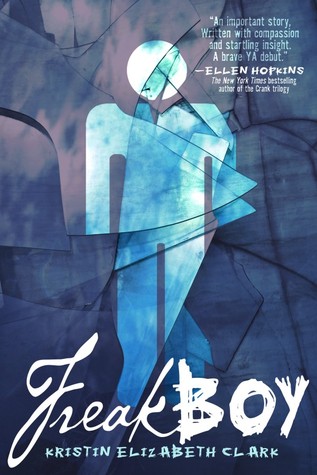
Freakboy by Kristin Elizabeth Clark


Clark, K. E. (2013). Freakboy. New York, NY: Farrar, Straus and Giroux.


Summary: Brendan Chase might appear to have the perfect life to some. He is on the wrestling team and has a beautiful girlfriend. But Brendan has a secret. Sometimes he doesn't feel like society asks him to feel. In verse, along with two other narrators, Brendan shares his secret and Kristin Elizabeth Clark explores the topic of gender fluidity.

Review: Clark's Freakboy is a powerful read. This book is so necessary in school libraries for all students. Due to some of the sex scenes, I would assign this as 8th grade and up. But many sections of the book could be excerpted for a younger audience. Because Clark writes in verse, this novel moves quickly and the words are razor sharp.

Diversity: Clark explores gender fluidity--when a person doesn't feel like his/her assigned gender. There are few books written about this topic and also it is a diversity that is predominantly unseen by others. This voice is missing in YA literature. Brendan's (and Vanessa's) questioning of themselves normalizes this thought process for others and Angel's strong, decisive character gives us a role model. Gender fluidity is a topic that often doesn't come up when students discuss diversity in middle school. It's a story that is rarely mainstreamed or presented. Clark's novel can be that ally for young people and my hope that it's just the beginning of many other stories about questioning gender and sexuality to fill library shelves so that those who feel this way are not alone. This is a book that needs to be book-talked to students and with the cover faced out in libraries. It needs to be shown off and heard about so it doesn't go unnoticed. As teacher librarians, it's great to have the newest Rick Riordan, but it's books like these that need to be brought to the attention of students.

Suggestions for Teachers: Use this as a core text in an ELA classroom or excerpt it for younger audiences. Teach it as poetry and examine interior monologue, sensory description and diction. This is also a book to plug for independent reading or lit circles.

Reading Level:

  1. Quantitative: Lexile 800L, ATOS Book Level 5.8, Flesh-Kincaid 4.5. Readability Grade Level 6.0, RMM
  2. Qualitative: This text is moderately complex. There are three narrators and they are telling their side of the story. Each narrator tells his/her story chronologically, but there is no order or pattern and each narrator's story occurs unpredictably. Language is largely contemporary and explicit. Because the text is written in verse, there are more figurative language uses. Students who have some knowledge of gender fluidity will more easily comprehend the text.

Content Areas: English, Contemporary Issues

Common Core State Standards:

CCSS.ELA-LITERACY.RL.9-10.2
Determine a theme or central idea of a text and analyze in detail its development over the course of the text, including how it emerges and is shaped and refined by specific details; provide an objective summary of the text.
CCSS.ELA-LITERACY.RL.9-10.3
Analyze how complex characters (e.g., those with multiple or conflicting motivations) develop over the course of a text, interact with other characters, and advance the plot or develop the theme.
CCSS.ELA-LITERACY.RL.9-10.4
Determine the meaning of words and phrases as they are used in the text, including figurative and connotative meanings; analyze the cumulative impact of specific word choices on meaning and tone (e.g., how the language evokes a sense of time and place; how it sets a formal or informal tone).
CCSS.ELA-LITERACY.RL.9-10.5
Analyze how an author's choices concerning how to structure a text, order events within it (e.g., parallel plots), and manipulate time (e.g., pacing, flashbacks) create such effects as mystery, tension, or surprise.
Subjects/Themes: LGBTQQ, gender fluidity, transgender, coming of age, identity

Awards: N/A
Series Information: N/A

Sunday, October 5, 2014

Sofi Mendoza's Guide to Getting Lost in Mexico by Malín Alegría


Alegría, M. (2007). Sofi Mendoza’s guide to getting lost in Mexico. New York, NY: Simon Pulse.


Summary: Sofi Mendoza is at a peak in her life. She's about to graduate high school and attend UCLA. It's the end of the year and her best friends are excited to attend a party at a classmate's house across the border in Rosarito, Mexico. Sofi is hoping for an opportunity to make a move on her big crush Nick. When the party is over, Sofi finds herself in a much larger dilemma. She is denied entry back into California. Sofi is forced to stay with an aunt whom she's never met until her parents can get a lawyer to argue her case. Family secrets are unveiled and cultural differences between Mexico and the US are highlighted. In the end, Sofi learns a lot about her ethnic heritage and Alegría highlights some of the serious injustices of the border and citizenship.

Review: This book is needed in schools (the references to underage drinking makes me give this book a high school designation). It is a "chick lit"romance that will attract many adolescent girls. There is enough happy ending romance here to please most. The ending is saccharine sweet and unfortunately, an unlikely-hood for most young adults put in this situation. While teens will like this book, I hope they understand that Sofi's status is unique and that the reality would be much dire.

Diversity: Alegría's voice is a much needed voice in YA literature. She gives voice to the Latina experience. Here, the Sofi speaks as a young woman who crossed the border at such a young age that she has no idea that her her immigration status is a lie. Other students could relate to this issue. Alegría also tells the story of culture shock--of what it means to represent a culture and then disappoint others because you are not "truly" Mexican and can't function as an "expert" (don't speak the language, have little knowledge of the country). (I can relate to this experience being half-Chinese, half Thai and speaking neither language.) While, I find this book needed in school libraries, it is not without complaint. Sofi is rather shallow through most of this book. Her need to impress boys and preoccupation with her outfits is ridiculous. Most disappointing is the ending which I find so far from reality. That immigration and deportation issues could be tied up so neatly in a bow within two weeks is far from reality and teens should have the opportunity to read the real dangers and outcomes of this situation in addition to this one. This book does give voice to the families who have a complicated history of living on both sides of the border and going back and forth over time. And my hope is that this book offers conversation and discussion about border issues among our youth. It should not be the only voice on Latino issues, but one of many. I realize that I've been judging this book harshly because it has become one of the handful of books I've read with a Latino protagonist so I want it to be more complicated than it is. I've fallen into Adichie's trap of the danger of a single story. I've read plenty of okay books about young white people and I don't have the same expectations because there are so many books about white people. There are few about Latinos and thus I'm putting all my hopes in one basket, which is unfair.

Suggestions for Teachers: Use this text alongside non-fiction articles about the US/Mexico border and border crossings. This could be one book in a collection of books for lit circles about immigration. This could be an independent reading text in a US history or government class as well.

Reading Level:

  1. Quantitative: Lexile 810L, ATOS Book Level 6.3, Flesh-Kincaid 6.4 Readability Grade Level 8.0, RMM 7
  2. Qualitative: This text is moderately complex. It is organized chronologically but there are a couple of subplots--what is happening in Mexico, what is happening back home at school. Language is largely contemporary and explicit but there are some words that are in Spanish, but can be defined using the glossary at the end of the book. The text is mostly literal. Students who have some knowledge of Latino culture will more easily comprehend the text.

Content Areas: English, Social Studies, Contemporary Issues

Common Core State Standards:

CCSS.ELA-LITERACY.RL.9-10.2
Determine a theme or central idea of a text and analyze in detail its development over the course of the text, including how it emerges and is shaped and refined by specific details; provide an objective summary of the text.
CCSS.ELA-LITERACY.RL.9-10.3
Analyze how complex characters (e.g., those with multiple or conflicting motivations) develop over the course of a text, interact with other characters, and advance the plot or develop the theme.
CCSS.ELA-LITERACY.RL.9-10.4
Determine the meaning of words and phrases as they are used in the text, including figurative and connotative meanings; analyze the cumulative impact of specific word choices on meaning and tone (e.g., how the language evokes a sense of time and place; how it sets a formal or informal tone).
CCSS.ELA-LITERACY.RL.9-10.6
Analyze a particular point of view or cultural experience reflected in a work of literature from outside the United States, drawing on a wide reading of world literature.
CCSS.ELA-LITERACY.RH.9-10.6
Compare the point of view of two or more authors for how they treat the same or similar topics, including which details they include and emphasize in their respective accounts.
Subjects/Themes: Immigration, Undocumented Immigrants, Border, US/Mexico Border
Awards: N/A
Series Information: N/A