Showing posts with label African American. Show all posts

Tuesday, December 2, 2014

When Louis Armstrong Taught Me Scat by Muriel Harris Weinstein; Illustrated by R. Gregory Christie


Weinstein, M. H. (2008). When Louis Armstrong taught me scat (R. G. Christie, Illustrator). San Francisco, CA: Chronicle Books.

Summary: A little girl goes to sleep and wakes up to Louis Armstrong. Armstrong takes her under his wing and teaches her to scat--make up songs by playing with words.

Review: This book is so fun. The illustrations help illustrate the clever songs.

Diversity: The little girl could be a person of color and Louis Armstrong is African American.

Suggestions for Teachers: Use this to introduce Louis Armstrong or to introduce onomatopoeia.

Reading Level:

  1. Quantitative: Lexile 420-820L, ATOS Book Level 2.75-5.14, Flesh-Kincaid 1.98-5.34, 3.53-6.13 RMM
  2. Qualitative: This text is slightly complex. It is organized chronologically. Vocabulary is mostly these made up song words that are fun to say. Some students might be confused by the girl dreaming. The beautiful colorful illustrations help students make meaning of the text. Knowledge of the Louis Armstrong will help students make meaning.
Content Areas: Language Arts

Common Core State Standards:


CCSS.ELA-LITERACY.RL.3.7
Explain how specific aspects of a text's illustrations contribute to what is conveyed by the words in a story (e.g., create mood, emphasize aspects of a character or setting)
Relevant Links: PBS, Biography.com, Teaching Books

Subjects/Themes: music, Louis Armstrong, jazz

Awards: N/A

Series Information: N/A

Monday, December 1, 2014

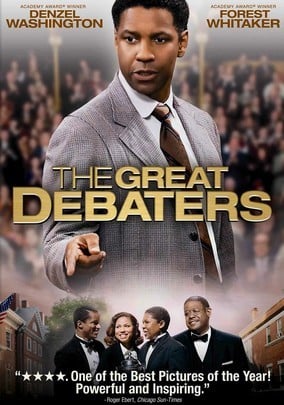
The Great Debaters directed by Denzel Washington (Oklahoma City clip)


Washington, D. (Director). (2007). The great debater debate Oklahoma City- VOST French subtitles. On The great debaters [Video file]. Retrieved from https://www.youtube.com/watch?v=lcllrqZgxwE

Summary: This clip shows a competition in Oklahoma City debating the issue: Should Blacks be allowed at the same colleges as Whites?  It is a 4:33 min clip.

Review:  This is a great clip to use to teach rebuttal and have students follow argument threads.

Diversity: African American students are the focus and here they are the underdogs.


Suggestions for Teachers: This is a perfect clip for teaching the art of rebuttal. You could have students take notes of the affirmative and negative arguments and draw lines between the two to show when one side has addressed the other's argument.

  1. Quantitative: N/A
  2. Qualitative: Students could use some background knowledge of the context if you are not going to show the whole film in class, but if you've been teaching debate than all they might need to know if the issue the sides are arguing. Watch it a few times and perhaps model how you would take notes off this debate for students to mirror. Otherwise it is set up perfectly to show rebuttal.
Content Areas: English, Drama

Common Core State Standards:


CCSS.ELA-LITERACY.CCRA.R.1
Read closely to determine what the text says explicitly and to make logical inferences from it; cite specific textual evidence when writing or speaking to support conclusions drawn from the text.
CCSS.ELA-LITERACY.CCRA.R.2
Determine central ideas or themes of a text and analyze their development; summarize the key supporting details and ideas.
CCSS.ELA-LITERACY.CCRA.R.3
Analyze how and why individuals, events, or ideas develop and interact over the course of a text.

Relevant links: Wikipedia
Subjects/Themes: English, Social Studies, segregation, Jim Crow


Awards: N/A

Series Information: N/A

Wednesday, November 26, 2014

This American Life: Is this Working? Review (actual media is shown right below this post)


Chicago Public Media, & Glass, I. (Producers). (2014, October 17). Is this working? [Show #538]. This American life from WBEZ. Podcast retrieved from http://www.thisamericanlife.org/radio-archives/episode/538/is-this-working


Summary: Act One of this episode talks about how Black and Latino children are being suspended as early as preschool way more than Whites.  Tunette Powell’s three and four year old children are getting suspended from preschool repeatedly.  Powell blames herself as a child who was repeatedly suspended and even expelled from preschool.  She thought it was because her father was in prison.  As an adult she believed with a two-parent household and a stable income, she was doing better for her kids.  Her kids’ suspensions make her wonder what she’s done wrong.  Then conversations with other kids’ parents at a birthday party make her realize that her children are being punished more frequently and for lesser offenses.  Powell writes a blog questioning the racism she is facing. 

Review:  This first 17-min clip is thought-provoking.  Anecdotally and statistically it is very rich.  Students could share their school experiences with discipline and their thoughts on justice in schools.  Who gets it?  Who doesn’t?  Lots of juicy questions for teenagers.  This podcast is perfect for the auditory learner.  It is well edited and the music helps engage all.  Using a reflection notebook, students could write down details about Powell’s story while listening.  

Diversity: Racism towards African American students is discussed extensively through this episode.


Suggestions for Teachers: A conversation about race in America would be a good pre-activity to prime students, but most will find this podcast engaging and disturbing. Use this to talk about current events in Ferguson and race in America in a Social Studies class.

Reading Level:

  1. Quantitative: N/A
  2. Qualitative: The stories and interviews used here are told in chronological order. Vocabulary is contemporary and largely familiar. No other context is needed to make meaning. A discussion about students' own racial experiences or a journal might be a good way to prime students.
Content Areas: English, Social Studies

Common Core State Standards:


CCSS.ELA-LITERACY.RI.11-12.2
Determine two or more central ideas of a text and analyze their development over the course of the text, including how they interact and build on one another to provide a complex analysis; provide an objective summary of the text.
CCSS.ELA-LITERACY.RI.11-12.3
Analyze a complex set of ideas or sequence of events and explain how specific individuals, ideas, or events interact and develop over the course of the text.
CCSS.ELA-LITERACY.RI.11-12.5
Analyze and evaluate the effectiveness of the structure an author uses in his or her exposition or argument, including whether the structure makes points clear, convincing, and engaging.
CCSS.ELA-LITERACY.RI.11-12.6
Determine an author's point of view or purpose in a text in which the rhetoric is particularly effective, analyzing how style and content contribute to the power, persuasiveness or beauty of the text.
CCSS.ELA-LITERACY.RI.11-12.7
Integrate and evaluate multiple sources of information presented in different media or formats (e.g., visually, quantitatively) as well as in words in order to address a question or solve a problem.
Relevant links: This American Life
Subjects/Themes: racism, discipline, education, African Americans


Awards: N/A

Series Information: This American Life


This American Life: Is this Working? #538 by Chicago Public Radio & Ira Glass


Chicago Public Media, & Glass, I. (Producers). (2014, October 17). Is this working? [Show #538]. This American life from WBEZ. Podcast retrieved from http://www.thisamericanlife.org/radio-archives/episode/538/is-this-working


Summary: Act One of this episode talks about how Black and Latino children are being suspended as early as preschool way more than Whites.  Tunette Powell’s three and four year old children are getting suspended from preschool repeatedly.  Powell blames herself as a child who was repeatedly suspended and even expelled from preschool.  She thought it was because her father was in prison.  As an adult she believed with a two-parent household and a stable income, she was doing better for her kids.  Her kids’ suspensions make her wonder what she’s done wrong.  Then conversations with other kids’ parents at a birthday party make her realize that her children are being punished more frequently and for lesser offenses.  Powell writes a blog questioning the racism she is facing. 

Review:  This first 17-min clip is thought-provoking.  Anecdotally and statistically it is very rich.  Students could share their school experiences with discipline and their thoughts on justice in schools.  Who gets it?  Who doesn’t?  Lots of juicy questions for teenagers.  This podcast is perfect for the auditory learner.  It is well edited and the music helps engage all.  Using a reflection notebook, students could write down details about Powell’s story while listening.  

Diversity: Racism towards African American students is discussed extensively through this episode.


Suggestions for Teachers: A conversation about race in America would be a good pre-activity to prime students, but most will find this podcast engaging and disturbing. Use this to talk about current events in Ferguson and race in America in a Social Studies class.

Reading Level:

  1. Quantitative: N/A
  2. Qualitative: The stories and interviews used here are told in chronological order. Vocabulary is contemporary and largely familiar. No other context is needed to make meaning. A discussion about students' own racial experiences or a journal might be a good way to prime students.
Content Areas: English, Social Studies

Common Core State Standards:


CCSS.ELA-LITERACY.RI.11-12.2
Determine two or more central ideas of a text and analyze their development over the course of the text, including how they interact and build on one another to provide a complex analysis; provide an objective summary of the text.
CCSS.ELA-LITERACY.RI.11-12.3
Analyze a complex set of ideas or sequence of events and explain how specific individuals, ideas, or events interact and develop over the course of the text.
CCSS.ELA-LITERACY.RI.11-12.5
Analyze and evaluate the effectiveness of the structure an author uses in his or her exposition or argument, including whether the structure makes points clear, convincing, and engaging.
CCSS.ELA-LITERACY.RI.11-12.6
Determine an author's point of view or purpose in a text in which the rhetoric is particularly effective, analyzing how style and content contribute to the power, persuasiveness or beauty of the text.
CCSS.ELA-LITERACY.RI.11-12.7
Integrate and evaluate multiple sources of information presented in different media or formats (e.g., visually, quantitatively) as well as in words in order to address a question or solve a problem.
Relevant links: This American Life
Subjects/Themes: racism, discipline, education, African Americans


Awards: N/A

Series Information: This American Life
<script src="http://audio.thisamericanlife.org/widget/widget.min.js" type="text/javascript"></script> <div id="this-american-life-538" class="this-american-life" style="width:540px;">

Saturday, November 22, 2014

The Port Chicago 50: Disaster, Mutiny and the Fight for Civil Rights by Steve Sheinkin


Sheinkin, S. (2014). The Port Chicago 50: Disaster, mutiny and the fight for civil rights. New York, NY: Roaring Brook.

Summary: In July 1944, an explosion killed 300 African American men and injured many more. Black men were stationed at this Bay Area naval base doing the dangerous work of loading heavy explosives onto ships without any training or safety measures. White officers ordered Black men to do this work even after the explosion. This is the story of the 50 men who said they wouldn't return to this job. These men were accused of mutiny and the punishment was death by rifle. This is their story.

Review: An accessible and fascinating look at one of the greatest injustices to African Americans, and arguably the birth of the Civil Rights Movement. Sheinkin makes the stories of Joe Small and his men come alive and you can't help but feel the moral contempt here. I kept wondering what I would have said or done. I only hoped to have been so brave.

Diversity: An beautiful portrayal of humanity and bravery of the Port Chicago 50.

Suggestions for Teachers: Teach this book for US history. Teach it as part of WWII. Teach it when teaching research and primary and secondary resources.

Reading Level:

  1. Quantitative: Lexile 950, ATOS Book Level 7.00-9.98, Flesh-Kincaid 6.51-10.34, 7.04-9.57 RMM
  2. Qualitative: This text is moderately complex. It is organized chronologically. Through personal stories, this text comes alive for readers. There is some technical vocabulary and there are lots of details that students may either be excited by or overwhelmed by, but Sheinkin does a phenomenal job of creating suspense. Knowledge of WWII and segregation will be helpful, but Sheinkin gives a lot of context for readers.
Content Areas: Social Studies

Common Core State Standards:

CCSS.ELA-LITERACY.RI.8.1
Cite the textual evidence that most strongly supports an analysis of what the text says explicitly as well as inferences drawn from the text.
CCSS.ELA-LITERACY.RI.8.2
Determine a central idea of a text and analyze its development over the course of the text, including its relationship to supporting ideas; provide an objective summary of the text.
CCSS.ELA-LITERACY.RI.8.3
Analyze how a text makes connections among and distinctions between individuals, ideas, or events (e.g., through comparisons, analogies, or categories).
CCSS.ELA-LITERACY.RI.8.6
Determine an author's point of view or purpose in a text and analyze how the author acknowledges and responds to conflicting evidence or viewpoints.
CCSS.ELA-LITERACY.RI.8.8
Delineate and evaluate the argument and specific claims in a text, assessing whether the reasoning is sound and the evidence is relevant and sufficient; recognize when irrelevant evidence is introduced.
CCSS.ELA-LITERACY.RI.8.9
Analyze a case in which two or more texts provide conflicting information on the same topic and identify where the texts disagree on matters of fact or interpretation.
Relevant links: Teaching BooksSteve Sheinkin
Subjects/Themes: family, acceptance, PTSD, trauma

Awards: N/A

Series Information: N/A

Friday, November 14, 2014

Kendra by Coe Booth


Booth, C. (2008). Kendra. New York, NY: Push.

Summary: Kendra lives in the Bronx with her grandmother. Her mother, only 14 years her senior, just finished her Ph.D. Kendra hopes to live with her mother. Her father lives upstairs with his younger sister and Kendra's best friend, Adonna. Kendra is trying to figure out puberty, boys and win her mother's acceptance.

Review: A raw book of coming-of-age. Compulsive and compelling. Due to the sex scenes, I would recommend this for a high school library.

Diversity: Strong and powerful female African American characters of low socio-economic status.

Suggestions for Teachers: Great for coming-of-age literature circle.

Reading Level:

  1. Quantitative: Lexile 770, ATOS Book Level 9.67-12.01, Flesh-Kincaid 8.32-12.12, 8.41-10.81 RMM
  2. Qualitative: This text is slightly complex; the organization is chronological and easy to follow. The language is also largely contemporary and familiar. Overall, this novel is very accessible. Knowledge of housing projects could help readers visualize more.
Content Areas: English

Common Core State Standards:

CCSS.ELA-LITERACY.RL.9-10.2
Determine a theme or central idea of a text and analyze in detail its development over the course of the text, including how it emerges and is shaped and refined by specific details; provide an objective summary of the text.
CCSS.ELA-LITERACY.RL.9-10.3
Analyze how complex characters (e.g., those with multiple or conflicting motivations) develop over the course of a text, interact with other characters, and advance the plot or develop the theme.

Relevant links: Teaching Books, Coe Booth
Subjects/Themes: family, acceptance


Awards: N/A

Series Information: N/A

Monday, September 15, 2014

Brown Girl Dreaming by Jacqueline Woodson

Woodson, J. (2014). brown girl dreaming. New York, NY: Nancy Paulsen Books. 


Summary:
Jacqueline Woodson's newest book is a memoir about her childhood during the 1960s and 70s written in verse.  Woodson begins with her early upbringing in Ohio, but most of her childhood includes long summers in South Carolina where her mother's parents lived and New York, where her mother moves as Jacqueline enters school.  Part of this memoir is a tribute to Woodson's long family history before her birth and the strength of her African American heritage.  Woodson's relationship with her grandmother, a strong Jehovah's Witness which later dictate her own religious practices are chronicled here.  This memoir is also a peek into the South during the early Civil Rights Movement, where Blacks are organizing as segregation is at its height.  Woodson is able to capture the essence of the time period through vivid sensory detail.

Review:
Woodson writes an evocative memoir in verse.  It is a tribute to family and how family shapes individuals.  It is also a bit of an exploration of her family tree.  A quick, beautiful read for those interested in Black history especially in the South during the late 1960's.

Suggestions for Teachers:
Students might have fun imitating sections of this book since it is written in verse.  Excerpts from this could be used at the beginning of the year for community building and units on memoirs or "Where I'm From" poems considering the work of Linda Christensen. There is also a lot in here on the power of reading and writing.  Those sections could be excerpted for the English classroom.  History teachers could use this as a primary text to go along with the textbook when studying Voting Rights Act, Civil Rights, the Black Panthers and also the effects of slavery and reconstruction.  Note: this is a quick read, but not a suspenseful one.  

Reading Level:
  1. Quantitative: Lexile 1350L, ATOS Book Level 4.5, Flesh-Kincaid 9.7, RMM 7.5, Readability Grade Level, 10.0, Titlewave RL: 4.3
  2. Qualitative:  The organization of brown girl dreaming is a little intricate.  There are time shifts back to before Jacqueline Woodson was born.  Since this memoir is written in verse, it has fairly complex language features including abstract ideas and figurative language.  At the same time, many of the sentence structures are very simple.  The vocabulary is mostly simple, but Woodson takes some liberties with language combining phrases into one word to sound more vernacular.   Woodson uses italics to indicate dialogue.  There is some vocabulary connected to a Southern context. Most of the knowledge demands are in the realm of what students know, but, students who have schema surrounding the Voting Rights Act, segregation, Civil Rights Movement, slavery and reconstruction and the Black Panther Party will have a stronger understanding of the text.  There are some Biblical references and knowledge surrounding Jehovah's Witnesses will be helpful.

Content Areas: English (teaching memoir, verse, sensory description, setting), History (1960s & 70's, Segregation, Voting Rights, Freedom Riders, Civil Rights, Black Panther Party)

Common Core State Standards:
  • CCSS.ELA-LITERACY.RH.6-8.4 Determine the meaning of words and phrases as they are used in a text, including vocabulary specific to domains related to history/social studies.
  • CCSS.ELA-LITERACY.RH.6-8.5 Describe how a text presents information (e.g., sequentially, comparatively, causally).
  • CCSS.ELA-LITERACY.RH.6-8.6 Identify aspects of a text that reveal an author's point of view or purpose (e.g., loaded language, inclusion or avoidance of particular facts).
Relevant Links/Digital Content: Teaching Books


Subjects/themes: African American history, women, Civil Rights, Voting Rights, Segregation, reading identity, writing identity
Awards: N/A as of today
Series Information:  N/A