Showing posts with label social studies. Show all posts

Wednesday, November 26, 2014

This American Life: Is this Working? Review (actual media is shown right below this post)


Chicago Public Media, & Glass, I. (Producers). (2014, October 17). Is this working? [Show #538]. This American life from WBEZ. Podcast retrieved from http://www.thisamericanlife.org/radio-archives/episode/538/is-this-working


Summary: Act One of this episode talks about how Black and Latino children are being suspended as early as preschool way more than Whites.  Tunette Powell’s three and four year old children are getting suspended from preschool repeatedly.  Powell blames herself as a child who was repeatedly suspended and even expelled from preschool.  She thought it was because her father was in prison.  As an adult she believed with a two-parent household and a stable income, she was doing better for her kids.  Her kids’ suspensions make her wonder what she’s done wrong.  Then conversations with other kids’ parents at a birthday party make her realize that her children are being punished more frequently and for lesser offenses.  Powell writes a blog questioning the racism she is facing. 

Review:  This first 17-min clip is thought-provoking.  Anecdotally and statistically it is very rich.  Students could share their school experiences with discipline and their thoughts on justice in schools.  Who gets it?  Who doesn’t?  Lots of juicy questions for teenagers.  This podcast is perfect for the auditory learner.  It is well edited and the music helps engage all.  Using a reflection notebook, students could write down details about Powell’s story while listening.  

Diversity: Racism towards African American students is discussed extensively through this episode.


Suggestions for Teachers: A conversation about race in America would be a good pre-activity to prime students, but most will find this podcast engaging and disturbing. Use this to talk about current events in Ferguson and race in America in a Social Studies class.

Reading Level:

  1. Quantitative: N/A
  2. Qualitative: The stories and interviews used here are told in chronological order. Vocabulary is contemporary and largely familiar. No other context is needed to make meaning. A discussion about students' own racial experiences or a journal might be a good way to prime students.
Content Areas: English, Social Studies

Common Core State Standards:


CCSS.ELA-LITERACY.RI.11-12.2
Determine two or more central ideas of a text and analyze their development over the course of the text, including how they interact and build on one another to provide a complex analysis; provide an objective summary of the text.
CCSS.ELA-LITERACY.RI.11-12.3
Analyze a complex set of ideas or sequence of events and explain how specific individuals, ideas, or events interact and develop over the course of the text.
CCSS.ELA-LITERACY.RI.11-12.5
Analyze and evaluate the effectiveness of the structure an author uses in his or her exposition or argument, including whether the structure makes points clear, convincing, and engaging.
CCSS.ELA-LITERACY.RI.11-12.6
Determine an author's point of view or purpose in a text in which the rhetoric is particularly effective, analyzing how style and content contribute to the power, persuasiveness or beauty of the text.
CCSS.ELA-LITERACY.RI.11-12.7
Integrate and evaluate multiple sources of information presented in different media or formats (e.g., visually, quantitatively) as well as in words in order to address a question or solve a problem.
Relevant links: This American Life
Subjects/Themes: racism, discipline, education, African Americans


Awards: N/A

Series Information: This American Life


This American Life: Is this Working? #538 by Chicago Public Radio & Ira Glass


Chicago Public Media, & Glass, I. (Producers). (2014, October 17). Is this working? [Show #538]. This American life from WBEZ. Podcast retrieved from http://www.thisamericanlife.org/radio-archives/episode/538/is-this-working


Summary: Act One of this episode talks about how Black and Latino children are being suspended as early as preschool way more than Whites.  Tunette Powell’s three and four year old children are getting suspended from preschool repeatedly.  Powell blames herself as a child who was repeatedly suspended and even expelled from preschool.  She thought it was because her father was in prison.  As an adult she believed with a two-parent household and a stable income, she was doing better for her kids.  Her kids’ suspensions make her wonder what she’s done wrong.  Then conversations with other kids’ parents at a birthday party make her realize that her children are being punished more frequently and for lesser offenses.  Powell writes a blog questioning the racism she is facing. 

Review:  This first 17-min clip is thought-provoking.  Anecdotally and statistically it is very rich.  Students could share their school experiences with discipline and their thoughts on justice in schools.  Who gets it?  Who doesn’t?  Lots of juicy questions for teenagers.  This podcast is perfect for the auditory learner.  It is well edited and the music helps engage all.  Using a reflection notebook, students could write down details about Powell’s story while listening.  

Diversity: Racism towards African American students is discussed extensively through this episode.


Suggestions for Teachers: A conversation about race in America would be a good pre-activity to prime students, but most will find this podcast engaging and disturbing. Use this to talk about current events in Ferguson and race in America in a Social Studies class.

Reading Level:

  1. Quantitative: N/A
  2. Qualitative: The stories and interviews used here are told in chronological order. Vocabulary is contemporary and largely familiar. No other context is needed to make meaning. A discussion about students' own racial experiences or a journal might be a good way to prime students.
Content Areas: English, Social Studies

Common Core State Standards:


CCSS.ELA-LITERACY.RI.11-12.2
Determine two or more central ideas of a text and analyze their development over the course of the text, including how they interact and build on one another to provide a complex analysis; provide an objective summary of the text.
CCSS.ELA-LITERACY.RI.11-12.3
Analyze a complex set of ideas or sequence of events and explain how specific individuals, ideas, or events interact and develop over the course of the text.
CCSS.ELA-LITERACY.RI.11-12.5
Analyze and evaluate the effectiveness of the structure an author uses in his or her exposition or argument, including whether the structure makes points clear, convincing, and engaging.
CCSS.ELA-LITERACY.RI.11-12.6
Determine an author's point of view or purpose in a text in which the rhetoric is particularly effective, analyzing how style and content contribute to the power, persuasiveness or beauty of the text.
CCSS.ELA-LITERACY.RI.11-12.7
Integrate and evaluate multiple sources of information presented in different media or formats (e.g., visually, quantitatively) as well as in words in order to address a question or solve a problem.
Relevant links: This American Life
Subjects/Themes: racism, discipline, education, African Americans


Awards: N/A

Series Information: This American Life
<script src="http://audio.thisamericanlife.org/widget/widget.min.js" type="text/javascript"></script> <div id="this-american-life-538" class="this-american-life" style="width:540px;">

Sunday, September 21, 2014

Life on Earth: The Story of Evolution by Steve Jenkins


Jenkins, S. (2002). Life on earth: The story of evolution. New York, NY: Houghton Mifflin.

Summary: Using beautiful pictures, Jenkins presents evolution. He illustrates how life has evolved over the past 4.5 billion years from single-celled organisms to complex modern human beings. Captions next to attractive pictures of species starting with how many billion years ago show this change from simple to complex. Jenkins also discusses evidence of how species have changed over time through Darwin's theory of natural selection or survival of the fittest and explains variation and mutation. Lastly, a 24-hr timeline analogy shows the how truly old the earth is.

Review: Jenkins' artwork and layout make this book really eye-catching and easy to understand. The art showing the finches' various beaks explains adaptation well. The example with the frogs shows natural selection clearly. Also, the timeline will help students grasp how long billions of years really is.

Suggestions for Teachers: This picture book could be used with various grade levels. It could be used as an interactive read aloud for students for an evolution unit. Teachers could also photograph pictures and have students put them in order as part of an anticipatory set or after as an informal assessment. Art teachers may use the art as models for creating art with various mediums.

Reading Level:

  1. Quantitative: Lexile 810L, ATOS Book Level 5.3, Flesh-Kincaid 4.9 Readability Grade Level 6.5, RMM 8.3
  2. Qualitative: The text structure is slightly complex as connections between ideas are made clear through pictures and captions. The graphics and captions definitely are necessary for young students in accessing content and comprehension. Jenkins works hard to make the language conventions straightforward and easy to understand. Once again, content-specific vocabulary like natural selection, variation and mutation are understood with the dependence of graphics. As a first pass at evolution, the purpose is clear, but re-reading with young students would be necessary to help cement the theory of evolution. Knowledge of cells, organisms and species would be helpful to comprehension. If students, have strong beliefs in creationism, they may struggle with the ideas in this text but Jenkins addresses that argument with lots of evidence.
Content Areas: Science, Social Studies, Art

Common Core State Standards:


CCSS.ELA-LITERACY.RI.5.2
Determine two or more main ideas of a text and explain how they are supported by key details; summarize the text.

CCSS.ELA-LITERACY.RI.5.3
Explain the relationships or interactions between two or more individuals, events, ideas, or concepts in a historical, scientific, or technical text based on specific information in the text.


CCSS.ELA-LITERACY.RI.5.4
Determine the meaning of general academic and domain-specific words and phrases in a text relevant to a grade 5 topic or subject area.
CCSS.ELA-LITERACY.RI.5.5
Compare and contrast the overall structure (e.g., chronology, comparison, cause/effect, problem/solution) of events, ideas, concepts, or information in two or more texts.
CCSS.ELA-LITERACY.RI.5.6
Analyze multiple accounts of the same event or topic, noting important similarities and differences in the point of view they represent.
CCSS.ELA-LITERACY.RI.5.8
Explain how an author uses reasons and evidence to support particular points in a text, identifying which reasons and evidence support which point(s).
Subjects/Themes: evolution, darwinism, natural selection, variation, mutation, beginning of the world
Awards: Horn Book, starred review
Series Information: N/A

Friday, September 19, 2014

Charles and Emma: The Darwins' Leap of Faith by Deborah Heiligman


Heiligman, D. (2009). Charles and Emma: The Darwins' leap of faith. New York, NY: Henry Holt and Company.
Summary:  Heiligman chronicles the marriage between Charles Darwin and his wife, first cousin, Emma Woodhouse.  Through Charles' and Emma's diaries and letters, Heiligman captures the beginning of the relationship when Charles is deciding if he is the marrying kind or if his scientific lifestyle will be burdened by marriage.  Over time, we see the true companionship of Emma and Charles as their family grows, faces tragedy and as Charles is beginning to make public his unpopular ideas of evolution.  Throughout it all, Emma, a devout Christian, not only stands by her husband, but holds him up.
Review:  Heiligman's work is a well-researched text.  She captures the Darwins' marriage well and gives backstory to a major figure who has influenced the way we think about our existence.  This isn't an easy read.  Many of my 7th graders struggled with it independently.  I think it could be excerpted well or used as an instructional text in middle or high school.
Suggestions for Teachers:  This text would work well for an interdisciplinary project among high/middle school English, social studies and science teachers.  Students could study the art of research and citing textual evidence in an English class.  They could also analyze the effects of narrative non-fiction.  This text could be compared to an expository text on evolution.  A social studies teacher could have students look at the historical events during Darwin's time through the course of reading this text and anticipate what kind of societal pressure Darwin was facing when publishing his ideas.  Science and social studies classes can look at evolution through a timeline of organisms that have evolved.  They can also examine animal variation and analyze the adaptations animals have made as a result of "survival of the fittest".   Social studies classes could also argue whether or not Charles and Emma's marriage was consistent with the time period.
Reading Level:


  1. Quantitative: Lexile 790L, ATOS Book Level 7.0, Readability Grade Level 7.7, Flesh-Kincaid 6.2, RMM 7.2
  2. Qualitative:  The text structure is moderately complex; it is told in chronological order.  The connections between ideas are clear.  The photos included in the center of the book help give understanding to the text and help the student keep track of the many children the Darwins had.  Heiligman includes a lot of direct quotations from Emma and Charles' diaries.  Some of the language is spelled differently and the phrasing is different than we use today.  These direct quotes do feel archaic.  However, Heiligman's prose is simple and fairly easy to understand. Heiligman's purpose is moderately complex and she wants to us to understand the marriage behind the man who posed such revolutionary ideas.  There are complex knowledge demands of the reader who will have to use schema of 19th century England to help fully understand the text.  
Content Areas: English, Science, Social Studies

Common Core State Standards:
CCSS.ELA-LITERACY.RH.9-10.1
Cite specific textual evidence to support analysis of primary and secondary sources, attending to such features as the date and origin of the information.
CCSS.ELA-LITERACY.RH.9-10.2
Determine the central ideas or information of a primary or secondary source; provide an accurate summary of how key events or ideas develop over the course of the text.
CCSS.ELA-LITERACY.RH.9-10.3
Analyze in detail a series of events described in a text; determine whether earlier events caused later ones or simply preceded them.
CCSS.ELA-LITERACY.RH.9-10.4
Determine the meaning of words and phrases as they are used in a text, including vocabulary describing political, social, or economic aspects of history/social science.
CCSS.ELA-LITERACY.RH.9-10.5
Analyze how a text uses structure to emphasize key points or advance an explanation or analysis.
CCSS.ELA-LITERACY.RH.9-10.6
Compare the point of view of two or more authors for how they treat the same or similar topics, including which details they include and emphasize in their respective accounts.
CCSS.ELA-LITERACY.RH.9-10.8
Assess the extent to which the reasoning and evidence in a text support the author's claims.
CCSS.ELA-LITERACY.RH.9-10.9
Compare and contrast treatments of the same topic in several primary and secondary sources.


Relevant Links: Teaching Books, Scholastic, Deborah Heiligman's website
Subject/Themes: evolution, Darwin, 19th century England, natural selection, research, marriage, relationships

Awards:
2010 National Book Award finalist
2010 Michael L. Printz Honor book (Watch a video of my Printz acceptance speech)
L.A. Times Book Prize Young Adult Literature finalist
New York Times Editor’s Choice – Click here to read the entire review.
Series Information: N/A


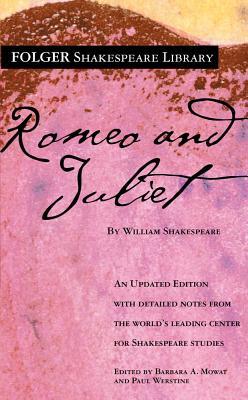
Romeo and Juliet by William Shakespeare (Folger Shakespeare Library Edition)


Mowat, B. A., & Werstine, P. (Eds.). (2011). Folger Shakespeare Library: Romeo 
     and Juliet by William Shakespeare. New York, NY: Simon and Schuster. 


Summary:  A longstanding grudge between two families has caused ongoing hostility in Verona, Italy.  The Montagues' son Romeo is out of sorts because he is in love with a woman who shares no interest in him.  His cousin Benvolio encourages him to go to a party to find another woman.  They crash the Capulet's family, the great enemy of the Montagues.  Capulet is hoping to marry his daughter Juliet off to County Paris.  While at the party, Romeo sets eyes on Juliet and falls in love at first sight.  The two decide to marry during a famous balcony scene later that evening.  But many unfortunate events caused by the families' feuding ultimately leads to their dual suicide.

Review:  This is by far my favorite edition to teach.  I probably taught with it 14 times with 9th grade students.  The format and the spacing is good for kids.  The notes provided on the left side of the page are accessible to students and the short summaries for each scene are easy to understand.  Folger also provides a lot of online support materials.

Suggestions for Teachers:  Use Folger's Shakespeare Set Free to help make teaching this text really interactive.  There are lots of activities from tableaus to blocking and rewriting scripts that make this by far a favorite unit for 9th graders who are sometimes craving reading a classic they've heard about over and over.  Do a side-by-side reading of Gareth Hinds' graphic novel and show clips from Zeferelli and Luhrmann's films.  Give them the plot in advance.  Even use key lines to act out the scene.  Create improvs of modern day scenarios to help engage  (I have written a bunch of these and can email!)  Look at modern Romeo and Juliet scenarios in the world as a connection to social studies.

Reading Level:


  1. Quantitative: Lexile 720L, ATOS Book Level 8.6, Readability Grade Level 4.8, Flesh-Kincaid 3.3, RMM 7.7 *There seems to be some inconsistency in the quantitative assessment.  From my background of teaching Romeo and Juliet, I would lean towards 8th-9th grade reading level.
  2. Qualitative:  Reading a play is a complex task on its own.  The reader is left to visualizing time and place and shifts in setting.  The organization here is very complex as there are subplots.  Language can be exceedingly complex but Folger does a great job of simplifying key lines and adding accessible summaries on the left hand side of the page.  There are multiple levels of meaning but a student doesn't need to understand all of them to get the gist of the play as a first pass.  Of course there are dated historical and some Biblical references, but with the support this edition provides, the knowledge demands are lessened.  The young, forbidden love theme and disagreement with parents will be easy to connect with most teens.
Content Areas: English (teaching Shakespeare), Social Studies

Common Core State Standards:


CCSS.ELA-LITERACY.RL.8.2
Determine a theme or central idea of a text and analyze its development over the course of the text, including its relationship to the characters, setting, and plot; provide an objective summary of the text.
CCSS.ELA-LITERACY.RL.8.3
Analyze how particular lines of dialogue or incidents in a story or drama propel the action, reveal aspects of a character, or provoke a decision.
CCSS.ELA-LITERACY.RL.8.4
Determine the meaning of words and phrases as they are used in a text, including figurative and connotative meanings; analyze the impact of specific word choices on meaning and tone, including analogies or allusions to other texts.
CCSS.ELA-LITERACY.RL.8.5
Compare and contrast the structure of two or more texts and analyze how the differing structure of each text contributes to its meaning and style.
CCSS.ELA-LITERACY.RL.8.7
Analyze the extent to which a filmed or live production of a story or drama stays faithful to or departs from the text or script, evaluating the choices made by the director or actors.
CCSS.ELA-LITERACY.RL.8.9
Analyze how a modern work of fiction draws on themes, patterns of events, or character types from myths, traditional stories, or religious works such as the Bible, including describing how the material is rendered new.
Relevant Links: There is so much out there just doing a quick search on google. But I love the Folger Shakespeare Library! Folger Digital Texts, Folger Shakespeare Library
Subject/Themes: love, forbidden love, parental pressure, Shakespeare, gangs, feuds, poetry, sonnet, play, drama
Awards: N/A
Series Information: Folger Shakespeare Library Series