Showing posts with label picture book. Show all posts

Friday, December 5, 2014

Bink & Gollie by Kate DiCamillo and Alison McGhee; Illustrated by Tony Fucile


DiCamillo, K., & McGhee, A. (2010). Bink & Gollie: Vol. 1. Bink & Gollie (T. Fucile, Illustrator). Somerville, MA: Candlewick Press.


Summary: Bink and Gollie are two best friends who go through three adventures together--not always agreeing, but always returning to their friendship.

Review: These girls are quirky and have wonderful imaginations. I love that they are so different from each other but still love each other's company. The illustrations are fantastic.

Diversity: Not much. Bink is a bit of a tomboy.

Suggestions for Teachers: This makes a wonderful addition to a classroom library.

Reading Level:

  1. Quantitative: Lexile 310L, ATOS Book Level 2.75-5.14, Flesh-Kincaid 1.98-5.34, 3.53-6.13RMM
  2. Qualitative: This text is moderately complex. Each individual story is arranged chronologically. Gollie uses sophisticated vocabulary that is more formal and a little archaic. The illustrations add wonderful context clues to help students make meaning.
Content Areas: English Language Arts

Common Core State Standards:


CCSS.ELA-LITERACY.RL.2.3
Describe how characters in a story respond to major events and challenges.
CCSS.ELA-LITERACY.RL.2.5
Describe the overall structure of a story, including describing how the beginning introduces the story and the ending concludes the action.
CCSS.ELA-LITERACY.RL.2.6
Acknowledge differences in the points of view of characters, including by speaking in a different voice for each character when reading dialogue aloud.
Relevant Links: Teaching Books

Subjects/Themes: friendship, adventure
Awards: Theodore Seuss Geisel Award


Series Information: Bink & Gollie #1

Wednesday, December 3, 2014

Salmon Forest by David Suzuki and Sarah Ellis; Illustrated by Sheena Lot


Suzuki, D., & Ellis, S. (2003). Salmon forest (S. Lot, Illustrator). Vancouver, British Columbia: Greystone Books.


Summary: Kate and Brett discover how salmon are connected to all parts of life in this northwestern forest.

Review: While I was annoyed with the names Kate and Brett, these two characters and their learning by observing nature make this an educational adventure story.

Diversity: Brett, Edna and Patricia could be part First Nation or Asian.

Suggestions for Teachers: Use this book when you teach about ecosystems, habitat, life cycles.

Reading Level:

  1. Quantitative: Lexile 740-1010L, ATOS Book Level 4.97-7.03, Flesh-Kincaid 4.51-7.72, 5.42-7.92 RMM
  2. Qualitative: This text is moderately complex. It is organized through Kate's observations and wonderings which are explained by her father. That is the repetitive pattern during most of the book. Conceptually, these ideas may be harder for students and multiple exposures of the life cycles would be helpful. Most of the vocabulary is familiar. The illustrations help give life to what could be rather dry. Those students with familiarity with life cycles, ecosystems and habitats will find this more accessible.
Content Areas: Science, Ecosystems

Common Core State Standards:


CCSS.ELA-LITERACY.RI.4.1
Refer to details and examples in a text when explaining what the text says explicitly and when drawing inferences from the text.
CCSS.ELA-LITERACY.RI.4.2
Determine the main idea of a text and explain how it is supported by key details; summarize the text.
Explain events, procedures, ideas, or concepts in a historical, scientific, or technical text, including what happened and why, based on specific information in the text.

Relevant Links: Teaching Books

Subjects/Themes: ecosystems, life cycles, salmon, habitat


Awards: N/A

Series Information: N/A

A Coyote Solstice Tale by Thomas King


King, T. (2009). A coyote solstice tale (G. Clement, Illustrator). Toronto, Ontario: Groundwood Books.

Summary: While waiting for his friends to arrive for dinner one winter night, Coyote is surprised with a strange little girl at his door. This little girl shows Coyote and his friends the evils of consumerism. While Coyote is briefly seduced, his friends and the little girl show him the light.

Review: A great book for kids to remind them of the simple joys of the holidays.

Diversity: Thomas King, the author, is part Cherokee and writes about First Nation issues.

Suggestions for Teachers: Use this book to read aloud during the winter holidays.

Reading Level:

  1. Quantitative: Lexile 740-1010L, ATOS Book Level 4.97-7.03, Flesh-Kincaid 4.51-7.72, 5.42-7.92 RMM
  2. Qualitative: This text is moderately complex. It is organized chronologically and written in verse. Some of the vocabulary is more formal than what students might be accustomed to. No prior knowledge is necessary, though those students with prior study in consumerism and capitalism will recognize it.
Content Areas: Language Arts

Common Core State Standards:


CCSS.ELA-LITERACY.RL.4.2
Determine a theme of a story, drama, or poem from details in the text; summarize the text.
CCSS.ELA-LITERACY.RL.4.4
Determine the meaning of words and phrases as they are used in a text, including those that allude to significant characters found in mythology (e.g., Herculean).
CCSS.ELA-LITERACY.RL.4.5
Explain major differences between poems, drama, and prose, and refer to the structural elements of poems (e.g., verse, rhythm, meter) and drama (e.g., casts of characters, settings, descriptions, dialogue, stage directions) when writing or speaking about a text.
Relevant Links: Teaching Books

Subjects/Themes: consumerism, capitalism

Awards: N/A

Series Information: N/A

Tuesday, December 2, 2014

Naked Mole Rat Gets Dressed by Mo Willems


Willems, M. (2009). Naked mole rat gets dressed. New York, NY: Hyperion Books for Children.

Summary: Wilbur is a naked mole rat who likes to wear clothes. Everyone in his community makes fun of him for doing so until a town meeting is called and Grandpah presides.

Review: This book is about staying true to who you are and being yourself.

Diversity: The identity and individuality could be interpreted as diversity and accepting differences.

Suggestions for Teachers: Use this to book to talk about difference.

Reading Level:

  1. Quantitative: Lexile 470L, ATOS Book Level 2.75-5.14, Flesh-Kincaid 1.98-5.34, 3.53-6.13 RMM
  2. Qualitative: This text is slightly complex. It is organized chronologically. Vocabulary is largely familiar and contemporary. "Proclamation" might be a difficult word. Some students might be confused about what a mole rat is. The beautiful and contrast between the colorful clothes and the drabness of everything else may highlight difference. Knowledge of the mole rats will help students make meaning.
Content Areas: Language Arts

Common Core State Standards:


CCSS.ELA-LITERACY.RL.3.7

Retell stories, including key details, and demonstrate understanding of their central message or lesson.
CCSS.ELA-LITERACY.RL.1.3
Describe characters, settings, and major events in a story, using key details.
CCSS.ELA-LITERACY.RL.1.7
Use illustrations and details in a story to describe its characters, setting, or events.
Relevant Links: Teaching Books

Subjects/Themes: individuality, identity, diversity, acceptance

Awards: N/A

Series Information: N/A

When Louis Armstrong Taught Me Scat by Muriel Harris Weinstein; Illustrated by R. Gregory Christie


Weinstein, M. H. (2008). When Louis Armstrong taught me scat (R. G. Christie, Illustrator). San Francisco, CA: Chronicle Books.

Summary: A little girl goes to sleep and wakes up to Louis Armstrong. Armstrong takes her under his wing and teaches her to scat--make up songs by playing with words.

Review: This book is so fun. The illustrations help illustrate the clever songs.

Diversity: The little girl could be a person of color and Louis Armstrong is African American.

Suggestions for Teachers: Use this to introduce Louis Armstrong or to introduce onomatopoeia.

Reading Level:

  1. Quantitative: Lexile 420-820L, ATOS Book Level 2.75-5.14, Flesh-Kincaid 1.98-5.34, 3.53-6.13 RMM
  2. Qualitative: This text is slightly complex. It is organized chronologically. Vocabulary is mostly these made up song words that are fun to say. Some students might be confused by the girl dreaming. The beautiful colorful illustrations help students make meaning of the text. Knowledge of the Louis Armstrong will help students make meaning.
Content Areas: Language Arts

Common Core State Standards:


CCSS.ELA-LITERACY.RL.3.7
Explain how specific aspects of a text's illustrations contribute to what is conveyed by the words in a story (e.g., create mood, emphasize aspects of a character or setting)
Relevant Links: PBS, Biography.com, Teaching Books

Subjects/Themes: music, Louis Armstrong, jazz

Awards: N/A

Series Information: N/A

The Story of Ferdinand by Munro Leaf; Drawings by Robert Lawson


Leaf, M. (1936). The story of Ferdinand (R. Lawson, Illustrator). New York, NY: Viking.

Summary: Ferdinand, a Spanish bull, loves sitting under a tree and smelling flowers. But, by accident he is taken to take on the bull-fighters of Madrid. This is what happens when a peaceful bull is faced with violence.

Review: This is a classic story that says it's okay to be peaceful. It is calm and gentle reminder that's it's okay to be who you are. You don't have to be someone you're not; you can be yourself.

Diversity: Ferdinand is a bull in Spain. There are Spanish bull-fighters and ladies as well.

Suggestions for Teachers: My children love this book. It makes a great read-aloud. It would be a good conversation piece. What is the author trying to tell us? What is the theme of this book? How are you like Ferdinand? How are you different?

Reading Level:

  1. Quantitative: Lexile 710L, ATOS Book Level 2.75-5.14, Flesh-Kincaid 1.98-5.34, 3.53 RMM
  2. Qualitative: This text is slightly complex. It is organized chronologically. Vocabulary is largely familiar although there are some Spanish words to describe people. The simple black and white illustrations help readers make meaning. Prior knowledge of Spain and bullfighting as well as peace and pacifism would help readers understand this text better.
Content Areas: Language Arts

Common Core State Standards:

CCSS.ELA-LITERACY.RL.2.2
Recount stories, including fables and folktales from diverse cultures, and determine their central message, lesson, or moral.
CCSS.ELA-LITERACY.RL.2.3
Describe how characters in a story respond to major events and challenges.
Relevant links: Teaching Books

Subjects/Themes: peace, violence, identity

Awards: N/A

Series Information: N/A

Wednesday, October 29, 2014

The Long Road by Luis Garay


Garay, L. (1997). The long road. Toronto, Canada: Tundra Books.


Summary: War breaks out in Nicaragua when José is visiting his grandmother in town. When he and his mother return, his family has disappeared and their village is in ruins. After several nights traveling by foot, they eventually cross the border. This picture book shows José and his mother's early struggles in a new country.
Review: A beautiful story that many students at my school will identify with.

Diversity: This picture book is a much needed story in classrooms right now especially in recent days when most of America has been watching the US close its doors on small children trying to enter the US for a better life. When I taught a 10th grade newcomer EL class, almost all of the students here in San Francisco had their own border crossing story and many included significant trauma. This book could be in classrooms as a jumping off point for students to share the experiences of leaving sometimes dangerous homes, losing family, and the difficulties children face when learning to live somewhere new. Luis, a Latino boy, represents so many students I know. I wish I knew about this book earlier.

Suggestions for Teachers: This book would be a great read-aloud text especially in an English language class or a newcomer class. It would also be a great text to have facing out in elementary classrooms and will give windows into the lives of immigrant children who come after experiencing trauma.

Reading Level:

  1. Quantitative: Lexile 740-1010L, ATOS Book Level 4.97-7.03, Flesh-Kincaid 4.51-7.72, 5.42-7.92 RMM
  2. Qualitative: This text is moderately complex; it is chronological and it is the story of a journey which will engage many students. The language is simple although there is a lot of text for each page. It is literal and the illustrations support José's difficult journey. The themes of escape to safety and adjustment to new situations are ones students will be able to understand. Those who have knowledge of war or immigration will have an easier time understanding this text.
Content Areas: Literacy, Family, Immigration, Acceptance, Refugees

Common Core State Standards:

CCSS.ELA-LITERACY.RL.4.2
Determine a theme of a story, drama, or poem from details in the text; summarize the text.
CCSS.ELA-LITERACY.RL.4.3
Describe in depth a character, setting, or event in a story or drama, drawing on specific details in the text (e.g., a character's thoughts, words, or actions).
CCSS.ELA-LITERACY.RL.4.9
Compare and contrast the treatment of similar themes and topics (e.g., opposition of good and evil) and patterns of events (e.g., the quest) in stories, myths, and traditional literature from different cultures.
Relevant links: Teaching Books, Immigration unit, Luis Garay website, Teacher's Guide

Subjects/Themes: family, acceptance, perseverance, discrimination, refugees, immigration


Awards: N/A

Series Information: N/A

10,000 Dresses by Marcus Ewert & Rex Ray


Ewert, M. (2008). 10,000 dresses (R. Ray, Illustrator). New York, NY: Seven Stories Press.

Summary: Bailey dreams about dresses, beautiful dresses of all kinds made of unusual and special materials. These are dresses she wants. Her parents aren't supportive of her dreams because she is "a boy". Bailey doesn't give up and finds someone to support her.

Review: A beautiful and bittersweet story. The parents infuriate me but I love how Bailey is able to find a friend and ally.

Diversity: This picture book focuses on a child who does not identify with her assigned gender. Bailey's story is such a needed story in elementary schools. Research shows that some children know they do not match with their assigned gender at really early ages, kindergarten or even preschool. This book is a mirror for those children and a window for other children.

Suggestions for Teachers: This book would be a great read-aloud text when studying identity. It also should be a book facing out in classroom libraries so students have access. It should be one that isn't passed up for book talks.

Reading Level:

  1. Quantitative: Lexile 540L, ATOS Book Level 2.75-5.14, Flesh-Kincaid 1.98-5.34, 3.53-6.13 RMM
  2. Qualitative: This text is moderately complex; it is chronological and there is repetition in events. The language is simple and the images help describe the immense possibility symbolized in Bailey's dream dresses. Understanding that symbolism will be difficult for some children. The themes of perseverance, acceptance and friendship are accessible. It might be difficult for young children to see parents as unsupportive. Older children may be able to make more meaning about the symbolism in this text.
Content Areas: Literacy, Family, Community

Common Core State Standards:

CCSS.ELA-LITERACY.RL.3.2
Recount stories, including fables, folktales, and myths from diverse cultures; determine the central message, lesson, or moral and explain how it is conveyed through key details in the text.
CCSS.ELA-LITERACY.RL.3.3
Describe characters in a story (e.g., their traits, motivations, or feelings) and explain how their actions contribute to the sequence of events
CCSS.ELA-LITERACY.RL.3.7
Explain how specific aspects of a text's illustrations contribute to what is conveyed by the words in a story (e.g., create mood, emphasize aspects of a character or setting)

Relevant links: YouTube Teacher's Guide, Teaching Books, Pillow Project

Subjects/Themes: family, community, acceptance, perseverance, discrimination

Awards: 
Finalist, 2008 Lambda Literary Awards
2009 Rainbow List Book
Honor Book, 2010 Stonewall Children's and Young Adult Literature Award

Series Information: N/A

Monday, October 27, 2014

Baseball Saved Us by Ken Mochizuki and Dom Lee

Mochizuki, K. (1993). Baseball saved us (D. Lee, Illustrator). New York, NY: Lee & Low Books.


Summary: Shorty is an okay baseball player and is often made fun of because of his size. He and is family are sent to an internment came during WWII where the poor quality of life causes tensions to run high. Shorty's father has Shorty help him build a baseball field in the camps. This entertainment increases the quality of life and improves Shorty's baseball skills. Shorty is able to transfer his perseverance to the ignorant and racist society he returns to when he is freed from the camp.

Review: This is a slice of life of historical fiction about Japanese Americans during WWII. It is a story many students who like baseball can relate to. I have read a few books about this particular event (the baseball field built) so I hope it isn't an overrepresentation of what was otherwise a horrific experience for many. But hopefully, students who read this picture book will begin to ask more questions about Japanese internment during WWII.

Diversity: This picture book is about a Japanese American boy during internment in WWII. It is historical fiction and that chronicles this specific ethnic group. For the purpose of teaching history, this is a great addition. However, this isn't a "normalized" experience. I would love to see more books about Japanese Americans in their everyday life now.

Suggestions for Teachers: This picture book would be a great addition for studying history. You could also use it on a unit on perseverance. It would make a great read-aloud or mentor text.

Reading Level:

  1. Quantitative: Lexile 550L, ATOS Book Level 3.9, Flesh-Kincaid 3.7, 4.83 RMM
  2. Qualitative: This text is moderately complex; it is chronological. For a second or third grade book, this has a lot of text. The language is simple although there are some words like "Jap", "Camp" with a capital C and words relevant to building that may need explaining. The theme of perseverance and acceptance during difficult times is accessible. Students who have prior knowledge of WWII, Japanese Internment and baseball will be able to make more meaning with this text. The pictures really enhance the meaning of this text and are literal.
Content Areas: Literacy, History, Family, Community

Common Core State Standards:


CCSS.ELA-LITERACY.RL.3.2
Recount stories, including fables, folktales, and myths from diverse cultures; determine the central message, lesson, or moral and explain how it is conveyed through key details in the text.
CCSS.ELA-LITERACY.RL.3.3
Describe characters in a story (e.g., their traits, motivations, or feelings) and explain how their actions contribute to the sequence of events
CCSS.ELA-LITERACY.RL.3.7
Explain how specific aspects of a text's illustrations contribute to what is conveyed by the words in a story (e.g., create mood, emphasize aspects of a character or setting)
Relevant links: Scholastic, Teaching Books, YouTube Read Aloud, YouTube Read Aloud 2, Teacher's Guide

Subjects/Themes: family, community, acceptance, perseverance, racism

Awards: 
Best Multicultural Title - Cuffies Award
Publisher's Weekly
Choices
Cooperative Children's Book Center (CCBC)
Editor's Choice
San Francisco Chronicle
Not Just for Children Anymore Selection
Children's Book Council

Series Information: N/A

Sunday, October 26, 2014

Chik Chak Shabbat by Mara Rockliff & Kyrsten Brooker

Rockliff, M. (2014). Chik chak Shabbat (K. Brooker, Illustrator). Somerville, MA: Candlewick Press.


Summary: Goldie Simcha makes cholent every Saturday night for the neighbors in her building. It is a special night where everyone comes together and hears Goldie's stories from her childhood. One Saturday, Goldie is sick and there is no cholent. The neighbors decide to bring their own special dishes over to Goldie's and Goldie appreciates her community.

Review: This is a modern, multicultural Stone Soup. It's a beautiful tribute to diverse communities taking care of each other. This picture book is great for urban communities with many different ethnic groups living in close proximity.

Diversity: Goldie Simcha is a Jewish woman who lives in an apartment building with a Latino family, an Italian woman, a Korean man and an Middle Eastern family. Goldie shares the Jewish tradition of Shabbat with her neighbors and when she can't cook for them, they cook for her sharing their cultural treats. Most importantly, they enjoy each other's company and the idea of not being together with Goldie sick is unfathomable to them. This picture book portrays diverse groups of people taking care of one another. It is not about one group of people, but a celebration of various cultures who appreciate one another.

Suggestions for Teachers: This picture book would be a great addition for a unit study on community and/or neighborhoods. It would ask students to think about their own neighborhoods and the people in their neighborhoods who take care of them.

Reading Level:

  1. Quantitative: Lexile 690L, ATOS Book Level 4.3, Flesh-Kincaid 4.7, Readability 5.9, 5.4 RMM
  2. Qualitative: This text is moderately complex; it is fairly chronological except for one flashback that Goldie has. There is some repetition with the appearance of the various neighbors. The language is simple although there are some cultural words like cholent and Shabbat which may need more explanation. The theme of community taking care of one another is simple and applicable in a school setting. Students who have prior knowledge of Shabbat and Jewish culture will access this book more easily though students who have no prior schema can make great inferences about Shabbat and cholent based on the context of this book. The pictures help give the sense of a busy apartment complex and give meaning to the text.

Content Areas: Literacy, History, Family, Community

Common Core State Standards:


CCSS.ELA-LITERACY.RL.1.2
Retell stories, including key details, and demonstrate understanding of their central message or lesson.
CCSS.ELA-LITERACY.RL.1.3
Describe characters, settings, and major events in a story, using key details.
CCSS.ELA-LITERACY.RL.1.4
Identify words and phrases in stories or poems that suggest feelings or appeal to the senses.
Relevant links:  Author's website

Subjects/Themes: family, community, Judaism

Awards: N/A

Series Information: N/A

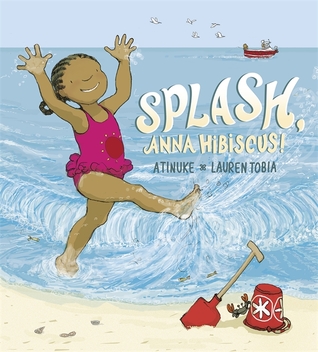
Splash, Anna Hibiscus! by Atinuke & Lauren Tobia


Atinuke, & Tobia, L. (2013). Splash, Anna Hibiscus! London: Kane Miller.


Summary: Anna Hibiscus lives in Africa with her family and friends. It is a hot day. She wants to play in the waves. Everyone seems too busy to play in the waves with her, so she decides to play with the waves themselves. Her joy is contagious and soon everyone who was too busy before decides to join Anna Hibiscus in the water.

Review: This is a beautiful picture book of a sweet girl who wants to enjoy her natural surroundings. The pictures are fun and engaging and the characters' names are also fun. It is a joyful book.

Diversity: This book features an African girl and her extended family and friends. Lots of beautiful pictures of people in various shades of brown. Anna Hibiscus's mother is white and her father is black so this shows a multiracial family and a close-knit, multi-generational, happy family at that. The only issue is that Anna Hibiscus lives in Africa, not a particular city or country in Africa, but Africa the continent which generalizes all Africans.

Suggestions for Teachers: This picture book would be a great addition for a unit study on families and what families look like. It would be a great read-aloud and a wonderful addition to a classroom library.

Reading Level:

  1. Quantitative: Lexile 500L, ATOS Book Level 4.0, Flesh-Kincaid 3.0,4.0 RMM
  2. Qualitative: This text is slightly complex as it is organized in a traditional manner with a recognizable pattern. Anna asks various members of her family to join her and they all are too busy until they realize how much fun she is having. The language is simple and the only hiccup for students may be the characters' unusual names as they are ideas and adjectives. The theme of doing something for yourself despite what others think is accessible. Students need no prior schema to access this book. The pictures do a wonderful job of showing the beauty of family and the joy of the ocean.
Content Areas: Literacy, Geography

Common Core State Standards:


CCSS.ELA-LITERACY.RL.2.2
Recount stories, including fables and folktales from diverse cultures, and determine their central message, lesson, or moral.
CCSS.ELA-LITERACY.RL.2.3
Describe how characters in a story respond to major events and challenges.
CCSS.ELA-LITERACY.RL.2.4
Describe how words and phrases (e.g., regular beats, alliteration, rhymes, repeated lines) supply rhythm and meaning in a story, poem, or song.
CCSS.ELA-LITERACY.RL.2.5
Describe the overall structure of a story, including describing how the beginning introduces the story and the ending concludes the action.
Relevant links:  Teaching Books, Read Aloud Video

Subjects/Themes: Africa, family, beach

Awards: N/A

Series Information: part of the Anna Hibiscus series

Sunday, September 21, 2014

Animal Poems by Valerie Worth, Illustrated by Steve Jenkins

     
Worth, V. (2007). Animal poems (S. Jenkins, Illustrator). New York, NY: Farrar Straus Giroux.

Summary: Valerie Worth's poems about animals are paired with Steve Jenkins multi-textured artwork.

Review: Worth's poetry ranges from simple to very difficult. Lots of vocabulary will be challenging for younger children but what a great vehicle to teach vocabulary and description.

Suggestions for Teachers: Older students could deconstruct and analyze poems. Younger students will enjoy hearing these poems read aloud. Individual poems could be paired with a science unit as an interactive read aloud. Students can use these poems as models to create their own animal poems. Art teachers can use the artwork as examples or models for students to create their own animals.


Reading Level:

  1. Quantitative: Lexile 1720L, ATOS Book Level 12.0, Flesh-Kincaid 23.6 Readability Grade Level 21.1, RMM N/A
  2. Qualitative:  This is an extremely complex text. As an adult, I struggled with visualizing because much of the vocabulary is content-specific to the animal itself. When testing the poem "Jellyfish" through the quantitative analyzers, I wasn't surprised to see this as grad school level. While the poems are short, they are filled with lots of dense, unfamiliar vocabulary. Other poems like "Cockroach" incorporate a first person narrator and other poems like "Groundhog" have two line stanzas. The structure and perspective shifts between poems. Poems have few complete stops and will take multiple reads to fully understand. Figurative language will also make poems challenging. The artwork is essential in making these poems more accessible.
Content Areas: English, Science, Art

Common Core State Standards:

CCSS.ELA-LITERACY.RL.5.2
Determine a theme of a story, drama, or poem from details in the text, including how characters in a story or drama respond to challenges or how the speaker in a poem reflects upon a topic; summarize the text.
CCSS.ELA-LITERACY.RL.5.4
Determine the meaning of words and phrases as they are used in a text, including figurative language such as metaphors and similes.
CCSS.ELA-LITERACY.RL.5.7
Analyze how visual and multimedia elements contribute to the meaning, tone, or beauty of a text (e.g., graphic novel, multimedia presentation of fiction, folktale, myth, poem).
CCSS.ELA-LITERACY.L.5.4.A
Use context (e.g., cause/effect relationships and comparisons in text) as a clue to the meaning of a word or phrase.

CCSS.ELA-LITERACY.L.5.5
Demonstrate understanding of figurative language, word relationships, and nuances in word meanings.
Relevant links: Scholastic
Subjects/Themes: poetry, animals, art
Awards: N/A
Series Information: N/A