Showing posts with label early elementary. Show all posts

Tuesday, December 2, 2014

When Louis Armstrong Taught Me Scat by Muriel Harris Weinstein; Illustrated by R. Gregory Christie


Weinstein, M. H. (2008). When Louis Armstrong taught me scat (R. G. Christie, Illustrator). San Francisco, CA: Chronicle Books.

Summary: A little girl goes to sleep and wakes up to Louis Armstrong. Armstrong takes her under his wing and teaches her to scat--make up songs by playing with words.

Review: This book is so fun. The illustrations help illustrate the clever songs.

Diversity: The little girl could be a person of color and Louis Armstrong is African American.

Suggestions for Teachers: Use this to introduce Louis Armstrong or to introduce onomatopoeia.

Reading Level:

  1. Quantitative: Lexile 420-820L, ATOS Book Level 2.75-5.14, Flesh-Kincaid 1.98-5.34, 3.53-6.13 RMM
  2. Qualitative: This text is slightly complex. It is organized chronologically. Vocabulary is mostly these made up song words that are fun to say. Some students might be confused by the girl dreaming. The beautiful colorful illustrations help students make meaning of the text. Knowledge of the Louis Armstrong will help students make meaning.
Content Areas: Language Arts

Common Core State Standards:


CCSS.ELA-LITERACY.RL.3.7
Explain how specific aspects of a text's illustrations contribute to what is conveyed by the words in a story (e.g., create mood, emphasize aspects of a character or setting)
Relevant Links: PBS, Biography.com, Teaching Books

Subjects/Themes: music, Louis Armstrong, jazz

Awards: N/A

Series Information: N/A

The Story of Ferdinand by Munro Leaf; Drawings by Robert Lawson


Leaf, M. (1936). The story of Ferdinand (R. Lawson, Illustrator). New York, NY: Viking.

Summary: Ferdinand, a Spanish bull, loves sitting under a tree and smelling flowers. But, by accident he is taken to take on the bull-fighters of Madrid. This is what happens when a peaceful bull is faced with violence.

Review: This is a classic story that says it's okay to be peaceful. It is calm and gentle reminder that's it's okay to be who you are. You don't have to be someone you're not; you can be yourself.

Diversity: Ferdinand is a bull in Spain. There are Spanish bull-fighters and ladies as well.

Suggestions for Teachers: My children love this book. It makes a great read-aloud. It would be a good conversation piece. What is the author trying to tell us? What is the theme of this book? How are you like Ferdinand? How are you different?

Reading Level:

  1. Quantitative: Lexile 710L, ATOS Book Level 2.75-5.14, Flesh-Kincaid 1.98-5.34, 3.53 RMM
  2. Qualitative: This text is slightly complex. It is organized chronologically. Vocabulary is largely familiar although there are some Spanish words to describe people. The simple black and white illustrations help readers make meaning. Prior knowledge of Spain and bullfighting as well as peace and pacifism would help readers understand this text better.
Content Areas: Language Arts

Common Core State Standards:

CCSS.ELA-LITERACY.RL.2.2
Recount stories, including fables and folktales from diverse cultures, and determine their central message, lesson, or moral.
CCSS.ELA-LITERACY.RL.2.3
Describe how characters in a story respond to major events and challenges.
Relevant links: Teaching Books

Subjects/Themes: peace, violence, identity

Awards: N/A

Series Information: N/A

Wednesday, October 29, 2014

10,000 Dresses by Marcus Ewert & Rex Ray


Ewert, M. (2008). 10,000 dresses (R. Ray, Illustrator). New York, NY: Seven Stories Press.

Summary: Bailey dreams about dresses, beautiful dresses of all kinds made of unusual and special materials. These are dresses she wants. Her parents aren't supportive of her dreams because she is "a boy". Bailey doesn't give up and finds someone to support her.

Review: A beautiful and bittersweet story. The parents infuriate me but I love how Bailey is able to find a friend and ally.

Diversity: This picture book focuses on a child who does not identify with her assigned gender. Bailey's story is such a needed story in elementary schools. Research shows that some children know they do not match with their assigned gender at really early ages, kindergarten or even preschool. This book is a mirror for those children and a window for other children.

Suggestions for Teachers: This book would be a great read-aloud text when studying identity. It also should be a book facing out in classroom libraries so students have access. It should be one that isn't passed up for book talks.

Reading Level:

  1. Quantitative: Lexile 540L, ATOS Book Level 2.75-5.14, Flesh-Kincaid 1.98-5.34, 3.53-6.13 RMM
  2. Qualitative: This text is moderately complex; it is chronological and there is repetition in events. The language is simple and the images help describe the immense possibility symbolized in Bailey's dream dresses. Understanding that symbolism will be difficult for some children. The themes of perseverance, acceptance and friendship are accessible. It might be difficult for young children to see parents as unsupportive. Older children may be able to make more meaning about the symbolism in this text.
Content Areas: Literacy, Family, Community

Common Core State Standards:

CCSS.ELA-LITERACY.RL.3.2
Recount stories, including fables, folktales, and myths from diverse cultures; determine the central message, lesson, or moral and explain how it is conveyed through key details in the text.
CCSS.ELA-LITERACY.RL.3.3
Describe characters in a story (e.g., their traits, motivations, or feelings) and explain how their actions contribute to the sequence of events
CCSS.ELA-LITERACY.RL.3.7
Explain how specific aspects of a text's illustrations contribute to what is conveyed by the words in a story (e.g., create mood, emphasize aspects of a character or setting)

Relevant links: YouTube Teacher's GuideTeaching BooksPillow Project

Subjects/Themes: family, community, acceptance, perseverance, discrimination

Awards: 
Finalist, 2008 Lambda Literary Awards
2009 Rainbow List Book
Honor Book, 2010 Stonewall Children's and Young Adult Literature Award

Series Information: N/A

Sunday, October 26, 2014

Chik Chak Shabbat by Mara Rockliff & Kyrsten Brooker

Rockliff, M. (2014). Chik chak Shabbat (K. Brooker, Illustrator). Somerville, MA: Candlewick Press.


Summary: Goldie Simcha makes cholent every Saturday night for the neighbors in her building. It is a special night where everyone comes together and hears Goldie's stories from her childhood. One Saturday, Goldie is sick and there is no cholent. The neighbors decide to bring their own special dishes over to Goldie's and Goldie appreciates her community.

Review: This is a modern, multicultural Stone Soup. It's a beautiful tribute to diverse communities taking care of each other. This picture book is great for urban communities with many different ethnic groups living in close proximity.

Diversity: Goldie Simcha is a Jewish woman who lives in an apartment building with a Latino family, an Italian woman, a Korean man and an Middle Eastern family. Goldie shares the Jewish tradition of Shabbat with her neighbors and when she can't cook for them, they cook for her sharing their cultural treats. Most importantly, they enjoy each other's company and the idea of not being together with Goldie sick is unfathomable to them. This picture book portrays diverse groups of people taking care of one another. It is not about one group of people, but a celebration of various cultures who appreciate one another.

Suggestions for Teachers: This picture book would be a great addition for a unit study on community and/or neighborhoods. It would ask students to think about their own neighborhoods and the people in their neighborhoods who take care of them.

Reading Level:

  1. Quantitative: Lexile 690L, ATOS Book Level 4.3, Flesh-Kincaid 4.7, Readability 5.9, 5.4 RMM
  2. Qualitative: This text is moderately complex; it is fairly chronological except for one flashback that Goldie has. There is some repetition with the appearance of the various neighbors. The language is simple although there are some cultural words like cholent and Shabbat which may need more explanation. The theme of community taking care of one another is simple and applicable in a school setting. Students who have prior knowledge of Shabbat and Jewish culture will access this book more easily though students who have no prior schema can make great inferences about Shabbat and cholent based on the context of this book. The pictures help give the sense of a busy apartment complex and give meaning to the text.

Content Areas: Literacy, History, Family, Community

Common Core State Standards:


CCSS.ELA-LITERACY.RL.1.2
Retell stories, including key details, and demonstrate understanding of their central message or lesson.
CCSS.ELA-LITERACY.RL.1.3
Describe characters, settings, and major events in a story, using key details.
CCSS.ELA-LITERACY.RL.1.4
Identify words and phrases in stories or poems that suggest feelings or appeal to the senses.
Relevant links:  Author's website

Subjects/Themes: family, community, Judaism

Awards: N/A

Series Information: N/A
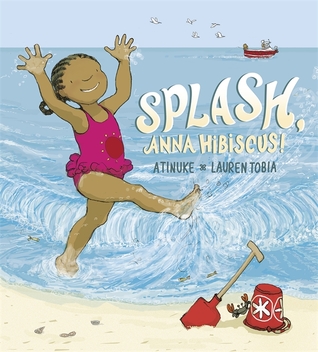
Splash, Anna Hibiscus! by Atinuke & Lauren Tobia


Atinuke, & Tobia, L. (2013). Splash, Anna Hibiscus! London: Kane Miller.


Summary: Anna Hibiscus lives in Africa with her family and friends. It is a hot day. She wants to play in the waves. Everyone seems too busy to play in the waves with her, so she decides to play with the waves themselves. Her joy is contagious and soon everyone who was too busy before decides to join Anna Hibiscus in the water.

Review: This is a beautiful picture book of a sweet girl who wants to enjoy her natural surroundings. The pictures are fun and engaging and the characters' names are also fun. It is a joyful book.

Diversity: This book features an African girl and her extended family and friends. Lots of beautiful pictures of people in various shades of brown. Anna Hibiscus's mother is white and her father is black so this shows a multiracial family and a close-knit, multi-generational, happy family at that. The only issue is that Anna Hibiscus lives in Africa, not a particular city or country in Africa, but Africa the continent which generalizes all Africans.

Suggestions for Teachers: This picture book would be a great addition for a unit study on families and what families look like. It would be a great read-aloud and a wonderful addition to a classroom library.

Reading Level:

  1. Quantitative: Lexile 500L, ATOS Book Level 4.0, Flesh-Kincaid 3.0,4.0 RMM
  2. Qualitative: This text is slightly complex as it is organized in a traditional manner with a recognizable pattern. Anna asks various members of her family to join her and they all are too busy until they realize how much fun she is having. The language is simple and the only hiccup for students may be the characters' unusual names as they are ideas and adjectives. The theme of doing something for yourself despite what others think is accessible. Students need no prior schema to access this book. The pictures do a wonderful job of showing the beauty of family and the joy of the ocean.
Content Areas: Literacy, Geography

Common Core State Standards:


CCSS.ELA-LITERACY.RL.2.2
Recount stories, including fables and folktales from diverse cultures, and determine their central message, lesson, or moral.
CCSS.ELA-LITERACY.RL.2.3
Describe how characters in a story respond to major events and challenges.
CCSS.ELA-LITERACY.RL.2.4
Describe how words and phrases (e.g., regular beats, alliteration, rhymes, repeated lines) supply rhythm and meaning in a story, poem, or song.
CCSS.ELA-LITERACY.RL.2.5
Describe the overall structure of a story, including describing how the beginning introduces the story and the ending concludes the action.
Relevant links:  Teaching Books, Read Aloud Video

Subjects/Themes: Africa, family, beach

Awards: N/A

Series Information: part of the Anna Hibiscus series

Sunday, September 21, 2014

Mission: Addition by Loren Leedy

Leedy, L. (1997). Mission: Addition. New York, NY: Holiday House. 

Summary: Miss Prime is a teacher and she explores addition with her students (animals) using real classroom examples. The lessons covered include: defining and practicing sums, adding numbers in the tens and ones column, adding many numbers, adding money, inventing word addition problems based on pictures, checking your work by adding again.

Review: This a colorful book and the animals will appeal to small children. The problems are simple and easy to understand for the most part. Its comic book style might confuse young readers on a first read on their own. There is a lot of text on the page.

Suggestions for Teachers: This would be a good book for a teacher to read aloud with students. After a first reading, students could read on their own with a notebook in hand to do the problems along with the book. A good extension activity would have students and teacher together come up with addition problems from the classroom.

Reading Level:

  1. Quantitative: Lexile 410L, ATOS Book Level 2.5, Flesh-Kincaid 0.3 Readability Grade Level 1.5, RMM 0.5
  2. Qualitative: The text structure is moderately complex as connections between ideas are made clear through pictures and dialogue bubbles. The graphics are definitely necessary to access the text because there is little expository text except for at the end of each chapter. Students will need to know how to read dialogue bubbles and the order in which to read comics to follow this text. Otherwise the language conventions are simple and conversational. Content-specific vocabulary like sum and addend is explained. The purpose is clear; students will understand that the book is about addition from the title and the repeated examples. Background knowledge of simple addition problems will make this a strong review text. It isn't simplistic enough to be instructional for addition. It would be good to supplement math curriculum and embed Common Core literacy standards in Math.
Content Areas: Math, Literacy

Common Core State Standards:

CCSS.MATH.CONTENT.K.CC.B.5
Count to answer "how many?" questions about as many as 20 things arranged in a line, a rectangular array, or a circle, or as many as 10 things in a scattered configuration; given a number from 1-20, count out that many objects.

Compare numbers.

CCSS.MATH.CONTENT.K.CC.C.6
Identify whether the number of objects in one group is greater than, less than, or equal to the number of objects in another group, e.g., by using matching and counting strategies.1
CCSS.MATH.CONTENT.K.CC.C.7
Compare two numbers between 1 and 10 presented as written numerals.
Use addition and subtraction within 20 to solve word problems involving situations of adding to, taking from, putting together, taking apart, and comparing, with unknowns in all positions, e.g., by using objects, drawings, and equations with a symbol for the unknown number to represent the problem.1
CCSS.MATH.CONTENT.1.OA.A.2
Solve word problems that call for addition of three whole numbers whose sum is less than or equal to 20, e.g., by using objects, drawings, and equations with a symbol for the unknown number to represent the problem.
CCSS.MATH.CONTENT.1.OA.D.7
Understand the meaning of the equal sign, and determine if equations involving addition and subtraction are true or false. For example, which of the following equations are true and which are false? 6 = 6, 7 = 8 - 1, 5 + 2 = 2 + 5, 4 + 1 = 5 + 2.
CCSS.ELA-LITERACY.RI.1.5
Know and use various text features (e.g., headings, tables of contents, glossaries, electronic menus, icons) to locate key facts or information in a text.
CCSS.ELA-LITERACY.RI.1.6
Distinguish between information provided by pictures or other illustrations and information provided by the words in a text.
Identify basic similarities in and differences between two texts on the same topic (e.g., in illustrations, descriptions, or procedures).7
Use the illustrations and details in a text to describe its key ideas.
Relevant links: Scholastic
Subjects/Themes: math, addition, word problems, sums
Awards: N/A
Series Information: N/A