Showing posts with label media. Show all posts

Monday, December 1, 2014

This I Believe essays


Special features. (2005). Retrieved December 1, 2014, from http://thisibelieve.org/feature/

Summary: This is a collection of "This I Believe" essays and podcasts organized by topic.  

Review:  These short essays are engaging and are often models to help students craft their own belief statements.

Diversity: These essays feature diverse voices.

Suggestions for Teachers: These essays can serve as models for students to craft their own personal essays. They also can be used with various topical units. They can be used to analyze the craft of this type of non-fiction. Students may also contribute their own personal essay to This I Believe.
  1. Quantitative: N/A
  2. Qualitative: No background information is necessary. These essays are meant to stand alone. Depending on the subject and author, language will vary although it is overall contemporary and familiar. Organization often includes anecdotes or memories to support evidence and thesis.
Content Areas: English, Contemporary Issues, Social Studies

Common Core State Standards:


CCSS.ELA-LITERACY.CCRA.R.1
Read closely to determine what the text says explicitly and to make logical inferences from it; cite specific textual evidence when writing or speaking to support conclusions drawn from the text.
CCSS.ELA-LITERACY.CCRA.R.2
Determine central ideas or themes of a text and analyze their development; summarize the key supporting details and ideas.
CCSS.ELA-LITERACY.CCRA.R.3
Analyze how and why individuals, events, or ideas develop and interact over the course of a text.

Relevant links: This I Believe
Subjects/Themes: English, Social Studies, Personal Narrative


Awards: N/A

Series Information: N/A

90-second Newbery Films created by students; started by author James Kennedy


Kennedy, J. (2013, July 4). 25 successful 90-second Newbery videos. Retrieved December 1, 2014, from http://jameskennedy.com/2013/07/04/the-25-most-popular-90-second-newbery-videos-so-far/

Summary: These are 25 of the most popular student-created 90-second Newbery films.  James Kennedy created a contest for students to make films that cover the entire plot of a Newbery winner or honor book in approximately 90 seconds.  

Review:  These films are great to watch when teaching Newbery books.  They are fun and display creativity of a variety of genres.

Diversity: Some films include students of color. However, many of the Newbery books are white in general.


Suggestions for Teachers: Great to inspire students to do their own book projects. An engaging idea to foster reading the whole book, identifying key plot points, collaborating and creating.
  1. Quantitative: N/A
  2. Qualitative: Students with knowledge of the particular Newbery book will understand these films better. However, these students could be used as a pre-reading activity to build schema. They are mostly organized chronologically. Some films use the actual dialogue from the text itself. Depending on the book, the language could be contemporary or more from that period. Students will be able to make meaning with the visual context clues.
Content Areas: English, Drama

Common Core State Standards:


CCSS.ELA-LITERACY.CCRA.R.1
Read closely to determine what the text says explicitly and to make logical inferences from it; cite specific textual evidence when writing or speaking to support conclusions drawn from the text.
CCSS.ELA-LITERACY.CCRA.R.2
Determine central ideas or themes of a text and analyze their development; summarize the key supporting details and ideas.
CCSS.ELA-LITERACY.CCRA.R.3
Analyze how and why individuals, events, or ideas develop and interact over the course of a text.

Relevant links: James Kennedy
Subjects/Themes: English, Drama


Awards: N/A

Series Information: N/A

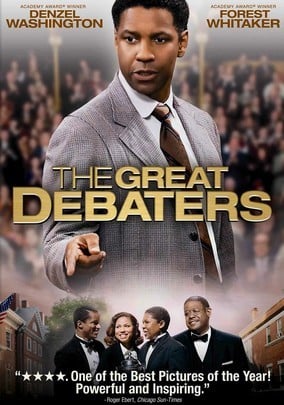
The Great Debaters directed by Denzel Washington (Oklahoma City clip)


Washington, D. (Director). (2007). The great debater debate Oklahoma City- VOST French subtitles. On The great debaters [Video file]. Retrieved from https://www.youtube.com/watch?v=lcllrqZgxwE

Summary: This clip shows a competition in Oklahoma City debating the issue: Should Blacks be allowed at the same colleges as Whites?  It is a 4:33 min clip.

Review:  This is a great clip to use to teach rebuttal and have students follow argument threads.

Diversity: African American students are the focus and here they are the underdogs.


Suggestions for Teachers: This is a perfect clip for teaching the art of rebuttal. You could have students take notes of the affirmative and negative arguments and draw lines between the two to show when one side has addressed the other's argument.

  1. Quantitative: N/A
  2. Qualitative: Students could use some background knowledge of the context if you are not going to show the whole film in class, but if you've been teaching debate than all they might need to know if the issue the sides are arguing. Watch it a few times and perhaps model how you would take notes off this debate for students to mirror. Otherwise it is set up perfectly to show rebuttal.
Content Areas: English, Drama

Common Core State Standards:


CCSS.ELA-LITERACY.CCRA.R.1
Read closely to determine what the text says explicitly and to make logical inferences from it; cite specific textual evidence when writing or speaking to support conclusions drawn from the text.
CCSS.ELA-LITERACY.CCRA.R.2
Determine central ideas or themes of a text and analyze their development; summarize the key supporting details and ideas.
CCSS.ELA-LITERACY.CCRA.R.3
Analyze how and why individuals, events, or ideas develop and interact over the course of a text.

Relevant links: Wikipedia
Subjects/Themes: English, Social Studies, segregation, Jim Crow


Awards: N/A

Series Information: N/A

Romeo + Juliet directed by Baz Luhrmann


Luhrmann, B. (Director). (1996). Romeo + Juliet [Motion picture]. USA: 20th Century Fox.

Summary: This is a modern day adaptation of William Shakespeare's classic set in Venice Beach, CA.

Review:  This is a fantastic adaptation!  So engaging with the music, costumes.  Students love it.

Diversity: A predominantly White cast although Mercutio is Black and Tybalt is Latino.


Suggestions for Teachers: Great to use when teaching the play and also alongside Zeferelli's classic version.

  1. Quantitative: N/A
  2. Qualitative: Students with knowledge of the play will have a stronger understanding of this text. While the costumes and setting are largely contemporary, the language is Shakespeare's original. It is well-edited and students will make meaning based on the visual context clues.
Content Areas: English, Drama

Common Core State Standards:


CCSS.ELA-LITERACY.CCRA.R.1
Read closely to determine what the text says explicitly and to make logical inferences from it; cite specific textual evidence when writing or speaking to support conclusions drawn from the text.
CCSS.ELA-LITERACY.CCRA.R.2
Determine central ideas or themes of a text and analyze their development; summarize the key supporting details and ideas.
CCSS.ELA-LITERACY.CCRA.R.3
Analyze how and why individuals, events, or ideas develop and interact over the course of a text.

Relevant links: Wikipedia
Subjects/Themes: English, drama, Romeo and Juliet


Awards: See here.

Series Information: N/A

The Matrix film directed by The Wachowskis


Wachowski, L., & Wachowski, A. (Directors). (1999). The matrix [Motion picture]. US: Warner Bros.


Summary: Thomas Anderson leads a mundane life as an office worker by day and a hacker by night.  He meets Morpheus who convinces him that once he knows the truth, he will never want to return to his old life and will try to convince others to see the truth too.

Review:  While there are some violent scenes, this is an excellent film for high school students when grappling Plato's Allegory of the Cave.

Diversity: Talk about characters who do not fit the "norm". Here it is cool to be alternative. Keanu Reeves and Laurence Fishburne are also men of color.


Suggestions for Teachers: Show clips of this film while teaching Plato's Allegory of the Cave. Read it with Malcolm X's "Learning to Read". What other texts talk about the truth being powerful?

Reading Level:

  1. Quantitative: N/A
  2. Qualitative: High interest and complex ideas. Students will be able to use this film to make meaning of Plato. Knowledge of computer hacking will help students make meaning. Overall, easy to follow.
Content Areas: English, Philosophy

Common Core State Standards:


CCSS.ELA-LITERACY.CCRA.R.1
Read closely to determine what the text says explicitly and to make logical inferences from it; cite specific textual evidence when writing or speaking to support conclusions drawn from the text.
CCSS.ELA-LITERACY.CCRA.R.2
Determine central ideas or themes of a text and analyze their development; summarize the key supporting details and ideas.
CCSS.ELA-LITERACY.CCRA.R.3
Analyze how and why individuals, events, or ideas develop and interact over the course of a text.

Relevant links: Wikipedia, History Guide
Subjects/Themes: philosophy, Plato, English


Awards: See here.

Series Information: N/A

Sunday, November 30, 2014

We Need Diverse Books Tumblr

We need diverse books tumblr. (n.d.). Retrieved November 30, 2014, from http://weneeddiversebooks.tumblr.com/


Summary: This tumblr is the cutting edge site for this campaign on the need for diversity in children and young adult literature.  Posts on the movement, interviews with authors of color, and the pulse of diversity in YA lit are here.

Review:  As a teacher librarian, being part of this movement is my job and I need to be informed.

Diversity: Enough said. Interviews with authors of color and lists of books with diverse protagonists are here.


Suggestions for Teachers: Use this website to talk to your students about why books need to represent the whole spectrum of diversity. Teach a unit analyzing book cover art and see whose faces are portrayed and whose aren't.

Reading Level:

  1. Quantitative: N/A
  2. Qualitative: Attractive. Great for browsing, a little harder to use for searching. This website is for all activists in the profession and for our young students activist who desperately want to change the face of YA lit so that all can find mirrors and windows in books. There is a lot of information here and it isn't organized in the most easy to find fashion so you have to do a little hunting. This would be great for a student's research project.
Content Areas: All

Common Core State Standards:


CCSS.ELA-LITERACY.CCRA.R.1
Read closely to determine what the text says explicitly and to make logical inferences from it; cite specific textual evidence when writing or speaking to support conclusions drawn from the text.
CCSS.ELA-LITERACY.CCRA.R.2
Determine central ideas or themes of a text and analyze their development; summarize the key supporting details and ideas.
CCSS.ELA-LITERACY.CCRA.R.3
Analyze how and why individuals, events, or ideas develop and interact over the course of a text.

Relevant links: We Need Diverse Books Tumblr, We Need Diverse Books Website
Subjects/Themes: teaching resources, diversity


Awards: N/A

Series Information: N/A

Ms. Yingling Reads


Yingling, K. (2014, November 30). Fantasy [Blog post]. Retrieved from http://msyinglingreads.blogspot.com/


Summary: Ms. Yingling's blog for middle school librarians and ELA teachers who are looking for the right book for each kid.  She publishes reviews daily and is especially thinking about how to get boys reading.

Review:  This blog is a great resource for librarians and teachers of middle school students.  There is a wealth of information for all kinds of middle grade books.  She gives a summary and then strengths and weaknesses.  Just reading for the strengths and weaknesses can help you develop your collection.

Diversity: Ms. Yingling is an ally the campaign for diverse books and often always features diverse books as soon as she gets them in her hands. Each Wed is devoted to reviews of diverse books.


Suggestions for Teachers: Use this website to develop your collection and to recommend books to your students.

Reading Level:

  1. Quantitative: N/A
  2. Qualitative: Easy to use layout, daily concise postings and good book lists. This is for professionals in education to get ideas about books for their students. Students could use Ms. Yingling's reviews to search for books they might like. The text is largely familiar to all. No prior knowledge is necessary.
Content Areas: English, Social Studies

Common Core State Standards:


CCSS.ELA-LITERACY.CCRA.R.1
Read closely to determine what the text says explicitly and to make logical inferences from it; cite specific textual evidence when writing or speaking to support conclusions drawn from the text.
CCSS.ELA-LITERACY.CCRA.R.2
Determine central ideas or themes of a text and analyze their development; summarize the key supporting details and ideas.
CCSS.ELA-LITERACY.CCRA.R.3
Analyze how and why individuals, events, or ideas develop and interact over the course of a text.

Relevant links: Ms. Yingling Reads
Subjects/Themes: teaching resources, ELA, Common Core, text complexity, lesson plans


Awards: N/A

Series Information: N/A

Wednesday, November 26, 2014

Teaching Books.net website


Teaching Books. (2001). Retrieved November 26, 2014, from http://teachingbooks.net


Summary: This is a one-stop shop website with supplementary online materials about all the books students read in schools.  Lesson plans, online videos with authors, readers theater scripts, interviews, text complexity analyses are all in one database set up for easy use.  

Review:  This is a great place for teachers and educators to find the vast collection of resources out there on the web about the books their students are reading.  It is a time saver.

Diversity: Every book I've searched for has been available; some have more limited information than others, but they exist. This includes authors of color.


Suggestions for Teachers: Use this website resource to help plan your ELA class and for students to have access to authors.

Reading Level:

  1. Quantitative: N/A
  2. Qualitative: Easy to use layout and materials are student friendly. This website will help teachers and students alike get schema for the text they are reading and more in-depth knowledge of the author of their text. This could be used either before reading the text or after to get insight on the reader's craft. No prior knowledge is necessary except for how to search a database.
Content Areas: English, Social Studies

Common Core State Standards:


CCSS.ELA-LITERACY.CCRA.R.1
Read closely to determine what the text says explicitly and to make logical inferences from it; cite specific textual evidence when writing or speaking to support conclusions drawn from the text.
CCSS.ELA-LITERACY.CCRA.R.2
Determine central ideas or themes of a text and analyze their development; summarize the key supporting details and ideas.
CCSS.ELA-LITERACY.CCRA.R.3
Analyze how and why individuals, events, or ideas develop and interact over the course of a text.


Relevant links: Teaching Books
Subjects/Themes: teaching resources, ELA, Common Core, text complexity, lesson plans


Awards: N/A

Series Information: N/A


This American Life: Is this Working? Review (actual media is shown right below this post)


Chicago Public Media, & Glass, I. (Producers). (2014, October 17). Is this working? [Show #538]. This American life from WBEZ. Podcast retrieved from http://www.thisamericanlife.org/radio-archives/episode/538/is-this-working


Summary: Act One of this episode talks about how Black and Latino children are being suspended as early as preschool way more than Whites.  Tunette Powell’s three and four year old children are getting suspended from preschool repeatedly.  Powell blames herself as a child who was repeatedly suspended and even expelled from preschool.  She thought it was because her father was in prison.  As an adult she believed with a two-parent household and a stable income, she was doing better for her kids.  Her kids’ suspensions make her wonder what she’s done wrong.  Then conversations with other kids’ parents at a birthday party make her realize that her children are being punished more frequently and for lesser offenses.  Powell writes a blog questioning the racism she is facing. 

Review:  This first 17-min clip is thought-provoking.  Anecdotally and statistically it is very rich.  Students could share their school experiences with discipline and their thoughts on justice in schools.  Who gets it?  Who doesn’t?  Lots of juicy questions for teenagers.  This podcast is perfect for the auditory learner.  It is well edited and the music helps engage all.  Using a reflection notebook, students could write down details about Powell’s story while listening.  

Diversity: Racism towards African American students is discussed extensively through this episode.


Suggestions for Teachers: A conversation about race in America would be a good pre-activity to prime students, but most will find this podcast engaging and disturbing. Use this to talk about current events in Ferguson and race in America in a Social Studies class.

Reading Level:

  1. Quantitative: N/A
  2. Qualitative: The stories and interviews used here are told in chronological order. Vocabulary is contemporary and largely familiar. No other context is needed to make meaning. A discussion about students' own racial experiences or a journal might be a good way to prime students.
Content Areas: English, Social Studies

Common Core State Standards:


CCSS.ELA-LITERACY.RI.11-12.2
Determine two or more central ideas of a text and analyze their development over the course of the text, including how they interact and build on one another to provide a complex analysis; provide an objective summary of the text.
CCSS.ELA-LITERACY.RI.11-12.3
Analyze a complex set of ideas or sequence of events and explain how specific individuals, ideas, or events interact and develop over the course of the text.
CCSS.ELA-LITERACY.RI.11-12.5
Analyze and evaluate the effectiveness of the structure an author uses in his or her exposition or argument, including whether the structure makes points clear, convincing, and engaging.
CCSS.ELA-LITERACY.RI.11-12.6
Determine an author's point of view or purpose in a text in which the rhetoric is particularly effective, analyzing how style and content contribute to the power, persuasiveness or beauty of the text.
CCSS.ELA-LITERACY.RI.11-12.7
Integrate and evaluate multiple sources of information presented in different media or formats (e.g., visually, quantitatively) as well as in words in order to address a question or solve a problem.
Relevant links: This American Life
Subjects/Themes: racism, discipline, education, African Americans


Awards: N/A

Series Information: This American Life


This American Life: Is this Working? #538 by Chicago Public Radio & Ira Glass


Chicago Public Media, & Glass, I. (Producers). (2014, October 17). Is this working? [Show #538]. This American life from WBEZ. Podcast retrieved from http://www.thisamericanlife.org/radio-archives/episode/538/is-this-working


Summary: Act One of this episode talks about how Black and Latino children are being suspended as early as preschool way more than Whites.  Tunette Powell’s three and four year old children are getting suspended from preschool repeatedly.  Powell blames herself as a child who was repeatedly suspended and even expelled from preschool.  She thought it was because her father was in prison.  As an adult she believed with a two-parent household and a stable income, she was doing better for her kids.  Her kids’ suspensions make her wonder what she’s done wrong.  Then conversations with other kids’ parents at a birthday party make her realize that her children are being punished more frequently and for lesser offenses.  Powell writes a blog questioning the racism she is facing. 

Review:  This first 17-min clip is thought-provoking.  Anecdotally and statistically it is very rich.  Students could share their school experiences with discipline and their thoughts on justice in schools.  Who gets it?  Who doesn’t?  Lots of juicy questions for teenagers.  This podcast is perfect for the auditory learner.  It is well edited and the music helps engage all.  Using a reflection notebook, students could write down details about Powell’s story while listening.  

Diversity: Racism towards African American students is discussed extensively through this episode.


Suggestions for Teachers: A conversation about race in America would be a good pre-activity to prime students, but most will find this podcast engaging and disturbing. Use this to talk about current events in Ferguson and race in America in a Social Studies class.

Reading Level:

  1. Quantitative: N/A
  2. Qualitative: The stories and interviews used here are told in chronological order. Vocabulary is contemporary and largely familiar. No other context is needed to make meaning. A discussion about students' own racial experiences or a journal might be a good way to prime students.
Content Areas: English, Social Studies

Common Core State Standards:


CCSS.ELA-LITERACY.RI.11-12.2
Determine two or more central ideas of a text and analyze their development over the course of the text, including how they interact and build on one another to provide a complex analysis; provide an objective summary of the text.
CCSS.ELA-LITERACY.RI.11-12.3
Analyze a complex set of ideas or sequence of events and explain how specific individuals, ideas, or events interact and develop over the course of the text.
CCSS.ELA-LITERACY.RI.11-12.5
Analyze and evaluate the effectiveness of the structure an author uses in his or her exposition or argument, including whether the structure makes points clear, convincing, and engaging.
CCSS.ELA-LITERACY.RI.11-12.6
Determine an author's point of view or purpose in a text in which the rhetoric is particularly effective, analyzing how style and content contribute to the power, persuasiveness or beauty of the text.
CCSS.ELA-LITERACY.RI.11-12.7
Integrate and evaluate multiple sources of information presented in different media or formats (e.g., visually, quantitatively) as well as in words in order to address a question or solve a problem.
Relevant links: This American Life
Subjects/Themes: racism, discipline, education, African Americans


Awards: N/A

Series Information: This American Life
<script src="http://audio.thisamericanlife.org/widget/widget.min.js" type="text/javascript"></script> <div id="this-american-life-538" class="this-american-life" style="width:540px;">

The Lizzie Bennet Diaries produced by Hank Green & Bernie Sue


Green, H., & Su, B. (Producers). (2012, April 9). My name is Lizzie Bennet [Show #1]. The Lizzie Bennet diaries. Podcast retrieved from http://www.pemberleydigital.com/the-lizzie-bennet-diaries/


Summary: This is a modern Pride and Prejudice with Lizzie Bennet a grad student in Mass Communications living at home with her parents. Mrs. Bennet is obsessed with marrying off all three of her daughters and is especially excited when millionaire and medical student Bing Lee moves into the neighborhood.

Review: A clever and engaging way to supplement teaching Jane Austen's masterpiece.

Diversity: In this vlog version, Charlotte is Asian and Bing Lee, Lizzie's love interest, is biracial.

Suggestions for Teachers: Each vlog is short and teachers could use clips to supplement reading assignments or for review.

Reading Level:

  1. Quantitative: N/A
  2. Qualitative: These videos are organized with Lizzie retelling various happenings in her household. She re-hashes these events by acting them out with her friend Charlotte. The story is organized chronologically. Vocabulary is largely contemporary and familiar. Students with knowledge of the plot of Pride and Prejudice will have greater interest and anticipation.
Content Areas: English

Common Core State Standards:


CCSS.ELA-LITERACY.RL.11-12.2
Determine two or more themes or central ideas of a text and analyze their development over the course of the text, including how they interact and build on one another to produce a complex account; provide an objective summary of the text.
CCSS.ELA-LITERACY.RL.11-12.3
Analyze the impact of the author's choices regarding how to develop and relate elements of a story or drama (e.g., where a story is set, how the action is ordered, how the characters are introduced and developed).
CCSS.ELA-LITERACY.RL.11-12.7
Analyze multiple interpretations of a story, drama, or poem (e.g., recorded or live production of a play or recorded novel or poetry), evaluating how each version interprets the source text. (Include at least one play by Shakespeare and one play by an American dramatist.)

Relevant links: Teaching Books
Subjects/Themes: family, marriage, romance

Awards: 
2012 TV. com Best Web Series – Winner
2013 IAWTV Awards – Best Interactive Series – Winner
2013 Streamy Awards – Best Comedy Series – Nominee
2013 Streamy Awards – Best Actress in a Comedy – Ashley Clements – Nominee
2013 Streamy Awards – Best Actress in a Comedy – Julia Cho – Nominee
2013 Streamy Awards – Best Ensemble Cast – Nominee
2013 Streamy Awards – Best Writing – Bernie Su – Winner
2013 Streamy Awards – Best Interactive Series – Jay BushmanAlexandra EdwardsBernie Su– Winner
2013 Primetime Emmy Award – Original Interactive Program – Winner
2013 PGA Awards – Best Online Series – Nominee
2014 Streamy Awards – Best Drama Series – Winner
2014 Streamy Awards – Best Actor in a Drama – Daniel Vincent Gordh – Nominee
2014 Streamy Awards – Best Actress in a Drama – Ashley Clements – Winner

Series Information: The Lizzie Bennet Diaries series