Sunday, October 26, 2014

Chik Chak Shabbat by Mara Rockliff & Kyrsten Brooker

Rockliff, M. (2014). Chik chak Shabbat (K. Brooker, Illustrator). Somerville, MA: Candlewick Press.


Summary: Goldie Simcha makes cholent every Saturday night for the neighbors in her building. It is a special night where everyone comes together and hears Goldie's stories from her childhood. One Saturday, Goldie is sick and there is no cholent. The neighbors decide to bring their own special dishes over to Goldie's and Goldie appreciates her community.

Review: This is a modern, multicultural Stone Soup. It's a beautiful tribute to diverse communities taking care of each other. This picture book is great for urban communities with many different ethnic groups living in close proximity.

Diversity: Goldie Simcha is a Jewish woman who lives in an apartment building with a Latino family, an Italian woman, a Korean man and an Middle Eastern family. Goldie shares the Jewish tradition of Shabbat with her neighbors and when she can't cook for them, they cook for her sharing their cultural treats. Most importantly, they enjoy each other's company and the idea of not being together with Goldie sick is unfathomable to them. This picture book portrays diverse groups of people taking care of one another. It is not about one group of people, but a celebration of various cultures who appreciate one another.

Suggestions for Teachers: This picture book would be a great addition for a unit study on community and/or neighborhoods. It would ask students to think about their own neighborhoods and the people in their neighborhoods who take care of them.

Reading Level:

  1. Quantitative: Lexile 690L, ATOS Book Level 4.3, Flesh-Kincaid 4.7, Readability 5.9, 5.4 RMM
  2. Qualitative: This text is moderately complex; it is fairly chronological except for one flashback that Goldie has. There is some repetition with the appearance of the various neighbors. The language is simple although there are some cultural words like cholent and Shabbat which may need more explanation. The theme of community taking care of one another is simple and applicable in a school setting. Students who have prior knowledge of Shabbat and Jewish culture will access this book more easily though students who have no prior schema can make great inferences about Shabbat and cholent based on the context of this book. The pictures help give the sense of a busy apartment complex and give meaning to the text.

Content Areas: Literacy, History, Family, Community

Common Core State Standards:


CCSS.ELA-LITERACY.RL.1.2
Retell stories, including key details, and demonstrate understanding of their central message or lesson.
CCSS.ELA-LITERACY.RL.1.3
Describe characters, settings, and major events in a story, using key details.
CCSS.ELA-LITERACY.RL.1.4
Identify words and phrases in stories or poems that suggest feelings or appeal to the senses.
Relevant links:  Author's website

Subjects/Themes: family, community, Judaism

Awards: N/A

Series Information: N/A

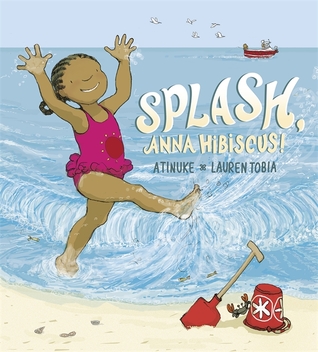
Splash, Anna Hibiscus! by Atinuke & Lauren Tobia


Atinuke, & Tobia, L. (2013). Splash, Anna Hibiscus! London: Kane Miller.


Summary: Anna Hibiscus lives in Africa with her family and friends. It is a hot day. She wants to play in the waves. Everyone seems too busy to play in the waves with her, so she decides to play with the waves themselves. Her joy is contagious and soon everyone who was too busy before decides to join Anna Hibiscus in the water.

Review: This is a beautiful picture book of a sweet girl who wants to enjoy her natural surroundings. The pictures are fun and engaging and the characters' names are also fun. It is a joyful book.

Diversity: This book features an African girl and her extended family and friends. Lots of beautiful pictures of people in various shades of brown. Anna Hibiscus's mother is white and her father is black so this shows a multiracial family and a close-knit, multi-generational, happy family at that. The only issue is that Anna Hibiscus lives in Africa, not a particular city or country in Africa, but Africa the continent which generalizes all Africans.

Suggestions for Teachers: This picture book would be a great addition for a unit study on families and what families look like. It would be a great read-aloud and a wonderful addition to a classroom library.

Reading Level:

  1. Quantitative: Lexile 500L, ATOS Book Level 4.0, Flesh-Kincaid 3.0,4.0 RMM
  2. Qualitative: This text is slightly complex as it is organized in a traditional manner with a recognizable pattern. Anna asks various members of her family to join her and they all are too busy until they realize how much fun she is having. The language is simple and the only hiccup for students may be the characters' unusual names as they are ideas and adjectives. The theme of doing something for yourself despite what others think is accessible. Students need no prior schema to access this book. The pictures do a wonderful job of showing the beauty of family and the joy of the ocean.
Content Areas: Literacy, Geography

Common Core State Standards:


CCSS.ELA-LITERACY.RL.2.2
Recount stories, including fables and folktales from diverse cultures, and determine their central message, lesson, or moral.
CCSS.ELA-LITERACY.RL.2.3
Describe how characters in a story respond to major events and challenges.
CCSS.ELA-LITERACY.RL.2.4
Describe how words and phrases (e.g., regular beats, alliteration, rhymes, repeated lines) supply rhythm and meaning in a story, poem, or song.
CCSS.ELA-LITERACY.RL.2.5
Describe the overall structure of a story, including describing how the beginning introduces the story and the ending concludes the action.
Relevant links:  Teaching Books, Read Aloud Video

Subjects/Themes: Africa, family, beach

Awards: N/A

Series Information: part of the Anna Hibiscus series

Friday, October 24, 2014

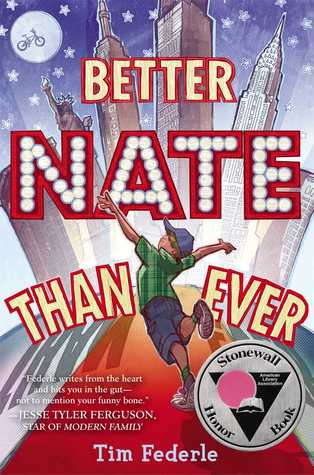
Better Nate Than Ever by Tim Federle


Federle, T. (2014). Better Nate than ever. New York, NY: Simon and Schuster for Young Readers.


Summary: Nate has a big dream. He wants to perform on Broadway. When an audition for a musical version of ET avails itself, Nate plans a surreptitious trip to NYC where hopes of being a star will allow him to feel more at home than he does in his own school.

Review: Federle brings us a character who is questioning his identity and takes us on a ride where we're rooting for Nate, the underdog, and wish him joy and happiness. A great coming of age story for youth.

Diversity: This novel features a kid who doesn't fit in. There are assumptions that Nate is questioning his sexual identity and teased by others at his school as effeminate and possibly gay. This is a story that isn't often told especially for middle grades and that is why I love this book because so many students who question their sexual identities start doing so long before high school where it is more prevalent in YA. This is a great middle school book and it offers a window and possibly a mirror for our youth struggling to figure out who they are.

Suggestions for Teachers: This novel would work well for lit circles with the guiding topic of coming-of-age. It would be a book that should be facing out in a classroom library and book talked.

Reading Level:

  1. Quantitative: Lexile 930L, ATOS Book Level 7.0, Flesh-Kincaid 6.51, 7.0 RMM
  2. Qualitative: This text is slightly complex as there is a singular first person narrator and the narration is chronological. Language is largely contemporary and explicit and thus moderately complex. The theme of an underdog achieving his dream is simple and accessible. Students who have some knowledge of Broadway and New York City might have a stronger understanding.

Content Areas: English, Contemporary Issues

Common Core State Standards:


CCSS.ELA-LITERACY.RL.6.1
Cite textual evidence to support analysis of what the text says explicitly as well as inferences drawn from the text.
CCSS.ELA-LITERACY.RL.6.2
Determine a theme or central idea of a text and how it is conveyed through particular details; provide a summary of the text distinct from personal opinions or judgments.
Describe how a particular story's or drama's plot unfolds in a series of episodes as well as how the characters respond or change as the plot moves toward a resolution.

Relevant links: Tim Federle's website, Teaching Books

Subjects/Themes: coming of age, LGBTQQ

Awards: Odyssey, Stonewall, ALA

Series Information: sequel is Five, Six, Seven Nate!

Thursday, October 23, 2014

Counting by 7s by Holly Goldberg Sloan


Sloan, H. G. (2013). Counting by 7s. New York, NY: Dial Books for Young Readers.


Summary: Willow is a quirky girl who suffers a tragedy at the beginning of this book leaving her without a family. Through unlikely friendships with others who are just as unique and different, Willow learns the true definition of family.

Review: Sloan gives us a tearjerker with Willow chance, a young girl who can master new languages and college textbooks better than she can navigate social interactions. Sloan's choice of diverse major characters is excellent and she gives voice to the often times voiceless here. It is a feel good novel that many students will enjoy.

Diversity: This novel features very diverse characters. First Willow, a person of color who might have autism is just one of the major characters. Mai and Quang-ha, are Willow's friends and they are the children of a feisty Vietnamese nail salon owner. And, Willow's early adult figure is Dell Duke, her counselor who struggles to function in his own life. This is a beautiful cast of characters who are marginalized in society and here they are front and center. I especially love Mai's mom, this nail salon worker who has such voice in this book when often times in popular culture, Vietnamese nail workers are shown serving rich, white women.

Suggestions for Teachers: This is a book that I would use for lit circles or independent reading. You could definitely use it to teach perspective maybe alongside or in place of Seedfolks.

Reading Level:

  1. Quantitative: Lexile 770L, ATOS Book Level 5.6, Flesh-Kincaid 3.9. Readability Grade Level 5.9, 7.6 RMM
  2. Qualitative: This text is moderately complex as there are various third-person perspective narrators. The narration is mostly chronological. Language is largely contemporary and explicit and thus moderately complex. The text has symbolism like the garden; students may only understand it literally but a teacher could choose to focus on symbolism here. Students who have some knowledge of autism and foster care might have a better understanding but it is not needed.

Content Areas: English, Contemporary Issues

Common Core State Standards:

CCSS.ELA-LITERACY.RL.7.1
Cite several pieces of textual evidence to support analysis of what the text says explicitly as well as inferences drawn from the text.


CCSS.ELA-LITERACY.RL.7.2
Determine a theme or central idea of a text and analyze its development over the course of the text; provide an objective summary of the text.
CCSS.ELA-LITERACY.RL.7.3
Analyze how particular elements of a story or drama interact (e.g., how setting shapes the characters or plot).
CCSS.ELA-LITERACY.RL.7.4
Determine the meaning of words and phrases as they are used in a text, including figurative and connotative meanings; analyze the impact of rhymes and other repetitions of sounds (e.g., alliteration) on a specific verse or stanza of a poem or section of a story or drama.
Relevant links: Teaching Books

Subjects/Themes: foster care, autism, coming of age, immigrant labor

Awards: A New York Times Bestseller. An AMAZON Best Book of the Year 2013.  A Kids' Indie Next List Top Ten Book-- #4, Best Books of Autumn 2013.  B.E.A. Buzz Book Award 2013.  A Texas Bluebonnet Award Nominee 2014-2015 Master List.  A School Library Journal Best Book of the Year.  An E.B. White Read Aloud Honor Book. A Dorothy Canfield Fisher Children's Book Award Nominee.  A National Public Radio Best Book of the Year.
Series Information: N/A

Wednesday, October 22, 2014

Zombie Baseball Beatdown by Paolo Bacigalupi


Bacigalupi, P. (2013). Zombie baseball beatdown. New York, NY: Little Brown and Company.


Summary: Rabi, Joe and Miguel are good friends and they are also on their local baseball team together. They practice on a field next to the meat-packing plant and lately something fishy is going on. Cows and humans alike are turning into zombies. Rabi and his friends investigate the mystery inside the factory to save the town and possibly the world.

Review: Bacigalupi tackles a lot more than just baseball and zombies in this book. He addresses food justice issues as well as ICE and the plight of being an undocumented immigrant. Through an adventure about zombies, readers are learning much more about the injustices in the world. The writing is clear and animated and will entice any middle schooler, especially boys.

Diversity: This novel isn't a story about diversity but it gives us diverse characters in an action-adventure. Rabi is half South Asian and half-White with a name no one can pronounce. His best friend Miguel is an undocumented boy from Mexico whose family has been deported. Joe is their white friend with dysfunctional and absentee parents. While the friends are fighting zombies, their identities contribute to their everyday existence and struggle and Bacigalupi normalizes and validates these experiences for readers, yet he does so in a way that doesn't tokenize any of the experiences.

Suggestions for Teachers: Use this as a core text in an ELA classroom or or teach excerpts of it with informational texts on food justice or immigration readings.

Reading Level:

  1. Quantitative: Lexile 1090L, ATOS Book Level 7.4, Flesh-Kincaid 7.3. Readability Grade Level 8.0, 6.2 RMM
  2. Qualitative: This text is slightly complex. The narration is chronological. Language is largely contemporary and explicit and thus moderately complex. Bacigalupi uses a lot of dialogue. The text has one level of meaning. Students who have some knowledge of factory farming and the plight of undocumented immigrants will more easily comprehend the text although this text could function as a great introduction to both of those issues.

Content Areas: English, Contemporary Issues

Common Core State Standards:

CCSS.ELA-LITERACY.RL.7.1
Cite several pieces of textual evidence to support analysis of what the text says explicitly as well as inferences drawn from the text.


CCSS.ELA-LITERACY.RL.7.2
Determine a theme or central idea of a text and analyze its development over the course of the text; provide an objective summary of the text.
CCSS.ELA-LITERACY.RL.7.3
Analyze how particular elements of a story or drama interact (e.g., how setting shapes the characters or plot).
CCSS.ELA-LITERACY.RL.7.4
Determine the meaning of words and phrases as they are used in a text, including figurative and connotative meanings; analyze the impact of rhymes and other repetitions of sounds (e.g., alliteration) on a specific verse or stanza of a poem or section of a story or drama.
Subjects/Themes: undocumented immigrants, ICE, factory farming, meat-packing industry, US-Mexico immigration

Awards: N/A
Series Information: N/A

Friday, October 17, 2014

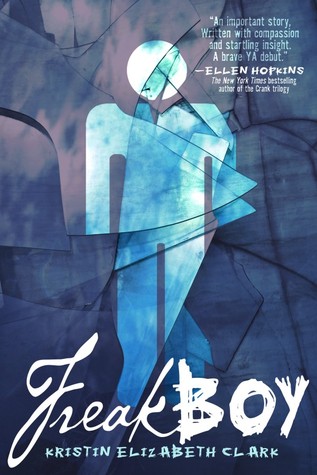
Freakboy by Kristin Elizabeth Clark


Clark, K. E. (2013). Freakboy. New York, NY: Farrar, Straus and Giroux.


Summary: Brendan Chase might appear to have the perfect life to some. He is on the wrestling team and has a beautiful girlfriend. But Brendan has a secret. Sometimes he doesn't feel like society asks him to feel. In verse, along with two other narrators, Brendan shares his secret and Kristin Elizabeth Clark explores the topic of gender fluidity.

Review: Clark's Freakboy is a powerful read. This book is so necessary in school libraries for all students. Due to some of the sex scenes, I would assign this as 8th grade and up. But many sections of the book could be excerpted for a younger audience. Because Clark writes in verse, this novel moves quickly and the words are razor sharp.

Diversity: Clark explores gender fluidity--when a person doesn't feel like his/her assigned gender. There are few books written about this topic and also it is a diversity that is predominantly unseen by others. This voice is missing in YA literature. Brendan's (and Vanessa's) questioning of themselves normalizes this thought process for others and Angel's strong, decisive character gives us a role model. Gender fluidity is a topic that often doesn't come up when students discuss diversity in middle school. It's a story that is rarely mainstreamed or presented. Clark's novel can be that ally for young people and my hope that it's just the beginning of many other stories about questioning gender and sexuality to fill library shelves so that those who feel this way are not alone. This is a book that needs to be book-talked to students and with the cover faced out in libraries. It needs to be shown off and heard about so it doesn't go unnoticed. As teacher librarians, it's great to have the newest Rick Riordan, but it's books like these that need to be brought to the attention of students.

Suggestions for Teachers: Use this as a core text in an ELA classroom or excerpt it for younger audiences. Teach it as poetry and examine interior monologue, sensory description and diction. This is also a book to plug for independent reading or lit circles.

Reading Level:

  1. Quantitative: Lexile 800L, ATOS Book Level 5.8, Flesh-Kincaid 4.5. Readability Grade Level 6.0, RMM
  2. Qualitative: This text is moderately complex. There are three narrators and they are telling their side of the story. Each narrator tells his/her story chronologically, but there is no order or pattern and each narrator's story occurs unpredictably. Language is largely contemporary and explicit. Because the text is written in verse, there are more figurative language uses. Students who have some knowledge of gender fluidity will more easily comprehend the text.

Content Areas: English, Contemporary Issues

Common Core State Standards:

CCSS.ELA-LITERACY.RL.9-10.2
Determine a theme or central idea of a text and analyze in detail its development over the course of the text, including how it emerges and is shaped and refined by specific details; provide an objective summary of the text.
CCSS.ELA-LITERACY.RL.9-10.3
Analyze how complex characters (e.g., those with multiple or conflicting motivations) develop over the course of a text, interact with other characters, and advance the plot or develop the theme.
CCSS.ELA-LITERACY.RL.9-10.4
Determine the meaning of words and phrases as they are used in the text, including figurative and connotative meanings; analyze the cumulative impact of specific word choices on meaning and tone (e.g., how the language evokes a sense of time and place; how it sets a formal or informal tone).
CCSS.ELA-LITERACY.RL.9-10.5
Analyze how an author's choices concerning how to structure a text, order events within it (e.g., parallel plots), and manipulate time (e.g., pacing, flashbacks) create such effects as mystery, tension, or surprise.
Subjects/Themes: LGBTQQ, gender fluidity, transgender, coming of age, identity

Awards: N/A
Series Information: N/A
Sunday, October 5, 2014

Sofi Mendoza's Guide to Getting Lost in Mexico by Malín Alegría


Alegría, M. (2007). Sofi Mendoza’s guide to getting lost in Mexico. New York, NY: Simon Pulse.


Summary: Sofi Mendoza is at a peak in her life. She's about to graduate high school and attend UCLA. It's the end of the year and her best friends are excited to attend a party at a classmate's house across the border in Rosarito, Mexico. Sofi is hoping for an opportunity to make a move on her big crush Nick. When the party is over, Sofi finds herself in a much larger dilemma. She is denied entry back into California. Sofi is forced to stay with an aunt whom she's never met until her parents can get a lawyer to argue her case. Family secrets are unveiled and cultural differences between Mexico and the US are highlighted. In the end, Sofi learns a lot about her ethnic heritage and Alegría highlights some of the serious injustices of the border and citizenship.

Review: This book is needed in schools (the references to underage drinking makes me give this book a high school designation). It is a "chick lit"romance that will attract many adolescent girls. There is enough happy ending romance here to please most. The ending is saccharine sweet and unfortunately, an unlikely-hood for most young adults put in this situation. While teens will like this book, I hope they understand that Sofi's status is unique and that the reality would be much dire.

Diversity: Alegría's voice is a much needed voice in YA literature. She gives voice to the Latina experience. Here, the Sofi speaks as a young woman who crossed the border at such a young age that she has no idea that her her immigration status is a lie. Other students could relate to this issue. Alegría also tells the story of culture shock--of what it means to represent a culture and then disappoint others because you are not "truly" Mexican and can't function as an "expert" (don't speak the language, have little knowledge of the country). (I can relate to this experience being half-Chinese, half Thai and speaking neither language.) While, I find this book needed in school libraries, it is not without complaint. Sofi is rather shallow through most of this book. Her need to impress boys and preoccupation with her outfits is ridiculous. Most disappointing is the ending which I find so far from reality. That immigration and deportation issues could be tied up so neatly in a bow within two weeks is far from reality and teens should have the opportunity to read the real dangers and outcomes of this situation in addition to this one. This book does give voice to the families who have a complicated history of living on both sides of the border and going back and forth over time. And my hope is that this book offers conversation and discussion about border issues among our youth. It should not be the only voice on Latino issues, but one of many. I realize that I've been judging this book harshly because it has become one of the handful of books I've read with a Latino protagonist so I want it to be more complicated than it is. I've fallen into Adichie's trap of the danger of a single story. I've read plenty of okay books about young white people and I don't have the same expectations because there are so many books about white people. There are few about Latinos and thus I'm putting all my hopes in one basket, which is unfair.

Suggestions for Teachers: Use this text alongside non-fiction articles about the US/Mexico border and border crossings. This could be one book in a collection of books for lit circles about immigration. This could be an independent reading text in a US history or government class as well.

Reading Level:

  1. Quantitative: Lexile 810L, ATOS Book Level 6.3, Flesh-Kincaid 6.4 Readability Grade Level 8.0, RMM 7
  2. Qualitative: This text is moderately complex. It is organized chronologically but there are a couple of subplots--what is happening in Mexico, what is happening back home at school. Language is largely contemporary and explicit but there are some words that are in Spanish, but can be defined using the glossary at the end of the book. The text is mostly literal. Students who have some knowledge of Latino culture will more easily comprehend the text.

Content Areas: English, Social Studies, Contemporary Issues

Common Core State Standards:

CCSS.ELA-LITERACY.RL.9-10.2
Determine a theme or central idea of a text and analyze in detail its development over the course of the text, including how it emerges and is shaped and refined by specific details; provide an objective summary of the text.
CCSS.ELA-LITERACY.RL.9-10.3
Analyze how complex characters (e.g., those with multiple or conflicting motivations) develop over the course of a text, interact with other characters, and advance the plot or develop the theme.
CCSS.ELA-LITERACY.RL.9-10.4
Determine the meaning of words and phrases as they are used in the text, including figurative and connotative meanings; analyze the cumulative impact of specific word choices on meaning and tone (e.g., how the language evokes a sense of time and place; how it sets a formal or informal tone).
CCSS.ELA-LITERACY.RL.9-10.6
Analyze a particular point of view or cultural experience reflected in a work of literature from outside the United States, drawing on a wide reading of world literature.
CCSS.ELA-LITERACY.RH.9-10.6
Compare the point of view of two or more authors for how they treat the same or similar topics, including which details they include and emphasize in their respective accounts.
Subjects/Themes: Immigration, Undocumented Immigrants, Border, US/Mexico Border
Awards: N/A
Series Information: N/A